 English English
Views: 0 Author: Site Editor Publish Time: 2026-05-18 Origin: Site


Investing in a WPC Door & Frame Machine requires balancing initial capital expenditure against long-term output stability, scrap reduction, and profile versatility. The global shift toward sustainable building materials makes this equipment highly sought after by modern production facilities. You want a robust setup. Manufacturers need equipment capable of running seamlessly across long shifts.
Producing high-density, warp-free WPC profiles remains technically demanding. The operational reality presents unique challenges for any factory. Success depends heavily on extrusion torque, mold precision, and the calibration setup. Manufacturers often struggle with uneven extrusion and warped profiles when they misjudge these critical factors. Inadequate cooling alone can ruin entire production runs.
This guide sets an evidence-based framework for evaluating machine specifications, facility requirements, and supplier credibility. We will explore core components, sizing strategies, and factory floor realities. You will learn how to engineer your plant layout for maximum efficiency. This ensures you secure a highly productive and stable manufacturing line from day one.
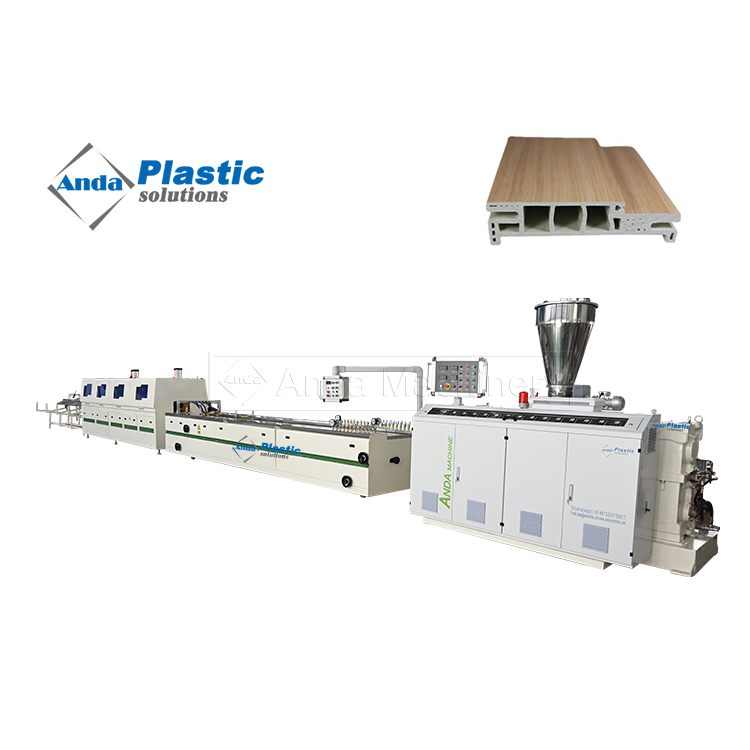
Core Technology: Twin-screw extruders are mandatory for handling standard WPC ratios (50-70% wood fiber) due to the high-torque mixing required.
Cooling is Critical: The vacuum calibration table dictates the straightness of the final product; inadequate cooling is the leading cause of warped profiles.
Output Targets: Machines must be specified to hit structural-grade density benchmarks (0.9–1.2 g/cm³) and moisture absorption rates (<0.5%).
Space & Process Planning: Post-extrusion, facilities must account for 24-48 hours of "seasoning" space to release material stress before cutting or surface treatment.
You cannot compromise on the primary extrusion unit. Twin-screw extruders are non-negotiable for producing wood-plastic composites. Standard single-screw machines simply lack the mechanical power necessary for these heavy mixtures. WPC formulations contain large volumes of wood powder. They also use thermoplastic resins like PVC, PE, or PP. Mixing these disparate materials requires superior shear forces.
Twin-screw systems provide precise melting and uniform dispersion. They force the plastic to encapsulate every wood fiber perfectly. This encapsulation prevents moisture absorption in the final product. High-torque gearboxes drive these screws. They prevent material stagnation inside the heated barrel. Stagnation causes the wood powder to burn, ruining the batch. We strongly advise inspecting the bimetallic wear-resistant coating on any screw you purchase.
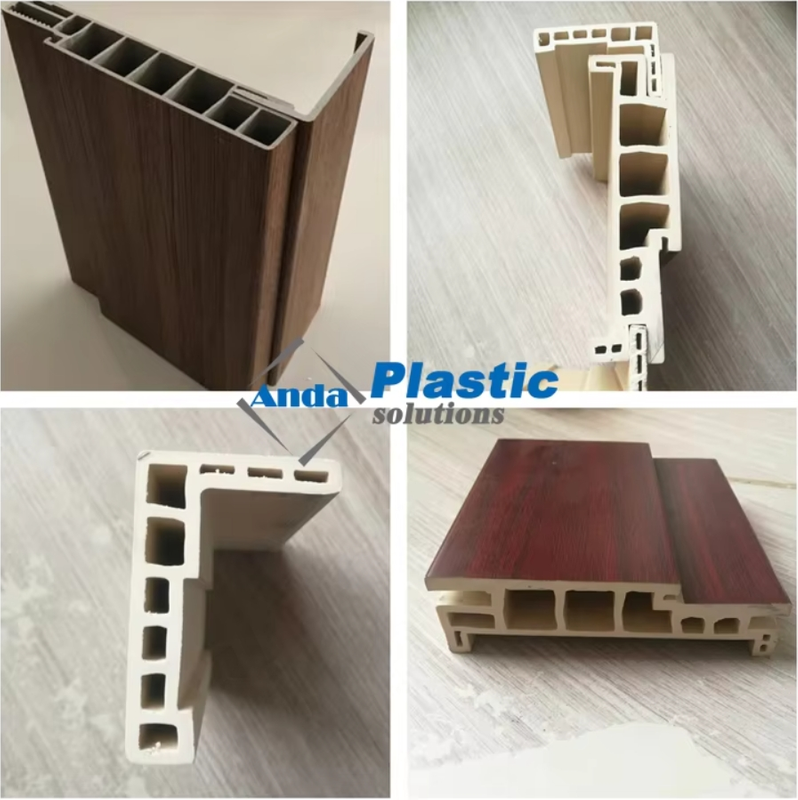
The die head shapes your molten material into its final profile. Engineering these molds requires extreme precision. You will typically choose between solid and hollow core profile molds.
Solid molds produce heavy, impact-resistant doors suitable for main entrances. They require massive extrusion pressure. Hollow structures serve interior applications. They reduce material costs while maintaining high structural integrity. Hollow molds demand precise internal webbing design. The die must distribute material evenly across intricate internal walls. If the flow rate fluctuates, the internal webbing collapses. This compromises the entire door frame.
Consider this the most critical stage for quality control. High-density WPC carries significant thermal mass exiting the die head. It retains heat much longer than standard PVC. Robust water and air cooling systems freeze the profile shape instantly.
Vacuum calibration tables pull the molten profile against metal sizing blocks. This guarantees dimensional accuracy. Inadequate cooling is the leading cause of warped profiles. You must match the length of your cooling table to your production speed. Faster lines need exceptionally long vacuum tanks to extract all residual heat. Otherwise, the profile warps hours later.
Once cooled, the profile needs pulling down the line. You need synchronized, variable-speed caterpillar haul-offs. These tractors grip the profile firmly without crushing the hollow cavities. They maintain steady tension. Sudden speed changes stretch or compress the hot material.
After traction, automated CNC saws cut profiles to exact lengths. WPC creates immense dust during cutting. You should prioritize dust-free cutting systems. They protect your workers and prevent particle buildup on the factory floor. Good CNC systems track the line speed seamlessly. They deliver perfectly square cuts without chipping the brittle edges.
You must align your machine specifications with your actual business model. Buying the biggest machine rarely guarantees the best operational results. Production lines generally fall into two categories.
Small-Scale Lines: These setups are ideal for high-mix, low-volume runs. Custom manufacturers frequently change mold sizes for bespoke frame orders. They prioritize quick changeovers over sheer speed. A smaller machine allows rapid heating and cooling adjustments. This agility helps custom shops turn around small orders profitably.
Medium to Large-Scale Lines: Large operations build these for 24/7 operation. They produce standardized profiles, like standard hollow-core door panels. They require advanced cooling lengths. They also need fully automated stacking systems to handle the high throughput. A large line running constantly maximizes raw material efficiency.
Comparison Chart: WPC Production Line Scales | |||
Production Scale | Primary Advantage | Ideal Product Mix | Cooling Requirement |
|---|---|---|---|
Small-Scale | Rapid Mold Changeovers | Custom trims, varied frame widths | Standard vacuum tables |
Medium-Scale | Balanced Output & Agility | Standard residential door frames | Extended calibration tanks |
Large-Scale | Uninterrupted 24/7 Volume | Standard hollow-core door panels | Maximum length + chilled water integration |
Target product specifications dictate your necessary machine power. Producing a heavy-duty structural frame requires hitting density benchmarks of 0.9–1.2 g/cm³. Pushing this dense material through a steel die demands immense force. You will need significantly higher motor kilowatts (kW) compared to producing lightweight decorative trim.
A machine underpowered for structural density will stall. The gearbox will suffer premature failure. You must communicate your target density to the equipment manufacturer immediately. They will calculate the appropriate torque rating. Over-engineering the gearbox slightly is a recognized industry best practice. It prevents catastrophic breakdowns during heavy production runs.
The best WPC Door & Frame Machine cannot fix wet raw material. Wood powder naturally absorbs moisture from the atmosphere. You must install an industrial-grade drying infrastructure.
High-speed compounding mixers are prerequisite equipment. They blend the dried wood powder with plastic resins and necessary additives. The friction inside the mixer heats the compound, driving out residual moisture. You must minimize wood powder moisture below 2% before extrusion. Wet material turns into steam inside the extruder barrel. This creates internal bubbles, ruining the profile's structural integrity.
Poor factory ventilation causes countless production failures. Extrusion and cooling zones generate massive ambient heat. If you fail to exhaust this heat, the surrounding air temperature spikes. Your water cooling system loses efficiency. It cannot pull heat away from the hot WPC profile fast enough.
Heat accumulation slows down line speed drastically. It also increases the scrap rate because profiles warp before they cool. You should install heavy-duty industrial exhaust fans directly above the vacuum calibration tables. Maintaining a controlled ambient temperature stabilizes your production parameters.
You cannot process WPC profiles immediately after they leave the cutting saw. Quality WPC manufacturing requires a strict "seasoning" resting period. Outline your factory layout to include a massive staging area.
Flat Stacking: Operators must stack the warm profiles on perfectly flat racks. Uneven racks induce permanent bows.
Time Duration: Profiles require 24 to 48 hours of resting time.
Stress Relief: This period allows internal material stresses to release safely.
Moisture Stabilization: Ambient moisture and internal temperatures equalize.
Skipping this step guarantees trouble. If you send unseasoned profiles directly to secondary processing, they will warp during cutting. Edge banding will peel off. Sanding will expose uneven internal densities.
Never accept delivery without a rigorous Factory Acceptance Test (FAT). Insist on running a sample batch using your specific formulation. If your recipe uses a 60/40 wood-to-plastic ratio, the supplier must prove the machine handles it.
During the test run, monitor the extruder loads. Measure the density of the output. Check the dimensional tolerances using digital calipers. A reputable supplier welcomes this scrutiny. They know successful commissioning prevents disputes later. Testing validates the screw design and die head precision under real-world pressures.
Check the provenance of all critical wear parts. The extruder screws and barrels face severe abrasion from the wood fibers. Ensure they use high-grade bimetallic steel. Look inside the electrical cabinet. Verify the PLC touchscreens, contactors, and variable frequency drives (VFDs) come from top-tier brands like Siemens, ABB, or Schneider.
Substandard motors and bearings fail under high-torque loads. Ask the supplier for a complete bill of materials. Transparent manufacturers happily list their component sources. Opaque suppliers usually hide inferior domestic parts behind generic labels.
Your relationship with the supplier truly begins after installation. Verify their ability to provide remote troubleshooting. Modern machines feature internet-connected PLCs. This allows engineers to diagnose faults from across the globe.
Ensure they offer rapid spare parts dispatch. You cannot afford a month-long shutdown waiting for a replacement heater band. Furthermore, operator training is critical. Improper temperature control is the number one cause of uneven extrusion. The supplier must teach your staff how to tune the heating zones perfectly.
Extruding the profile is only the first half of the manufacturing journey. You must prepare the raw doors and frames for the consumer market. Ensure your machine produces a surface finish compatible with downstream equipment.
A flawless extrusion allows for seamless integration with laminating machines. If the surface is wavy, PVC laminate films will bubble and peel. For modern aesthetics, many factories use 3D wood grain printing directly on the profile. This requires an absolutely flat substrate.
Robust edge-banding equipment ensures factory-grade waterproofing around the door perimeters. The density of your WPC must provide excellent screw-holding strength. Hinges and locksets require a solid bite into the material. If the extrusion is too porous, the hardware will sag over time. Integrating these secondary processes flawlessly elevates your product from a basic raw material to a premium architectural fixture.
Do not buy a machine based on maximum speed alone. Procurement logic demands a systematic approach. You must define your end-product requirements first. Decide on profile widths, target densities, and whether you need solid or hollow cores. These choices dictate everything else.
Once you define the product, calculate the necessary extrusion torque and cooling capacity. Over-specifying the gearbox and vacuum tables prevents costly bottlenecks later. Remember to lay out your factory floor carefully. Accommodate massive material prep stations and expansive profile seasoning areas. Proper workflow guarantees higher yields.
Finally, shortlist suppliers who offer transparent component sourcing. They must demonstrate proven commissioning experience with heavy wood-plastic ratios. A reliable manufacturing partner ensures your production line runs smoothly, yielding high-quality, warp-free architectural products for years to come.
A: Industry standards typically range between 50-70% wood fibers and 30-50% plastic polymers. The formulation also requires necessary chemical stabilizers, coupling agents, and UV additives to ensure durability and prevent fading.
A: Uneven output is usually an operational issue rather than a machine fault. The first troubleshooting step should always be checking for temperature fluctuations across the heating zones. Next, inspect the raw material flow to ensure the hopper is feeding consistently without blockages.
A: While possible by changing the mold (die head), door panels are significantly wider than frames. A machine sized perfectly for a wide door panel may be oversized and energy-inefficient for producing narrow frames. Factories at scale typically dedicate separate lines for doors and frames.
A: Ensure the vacuum cooling table is adequately sized for your profile's density. Maintain excellent workshop ventilation to prevent ambient heat buildup. Most importantly, strictly enforce a 24-48 hour flat-stacking "seasoning" period before you start secondary processing.


