 English English

Views: 0 Author: Site Editor Publish Time: 2026-10-28 Origin: Site


Rigid PVC extrusion manufacturing faces relentless margin compression. Off-spec production runs, start-up and shut-down waste, and continuous profile off-cuts create a compounding financial drain on factory floors. Many facilities attempt to solve this by running scrap through standard shredders and granulators. While this equipment successfully reduces the physical size of the scrap, it creates a new operational bottleneck. The resulting coarse regrind cannot be seamlessly reintroduced into twin-screw extruders. Feeding chunky regrind alongside fine virgin resin destroys melt stability. It compromises the structural integrity, ruins the surface finish, and drastically lowers the impact resistance of the final PVC pipe or profile.
You must bridge the gap between coarse chips and production-ready material. The solution requires precise micronization. Implementing an industrial PVC Pulverizer serves as the critical link in closed-loop recycling. It transforms inconsistent, bulky regrind into a uniform, reusable PVC powder that matches the exact flow characteristics of your virgin resin. This process eliminates waste, stabilizes extrusion parameters, and protects your profit margins against volatile raw material costs.
Standard granulators, chippers, and shredders fail to provide a complete solution for closed-loop PVC pipe and profile manufacturing. A granulator uses rotating knives to chop plastic parts into 8-12mm chips. These chips possess a drastically different bulk density compared to virgin PVC powder. Virgin powder is fine, heavy, and flows predictably. Coarse regrind is light, jagged, and highly prone to interlocking.
When you mix coarse chips with fine powder in an extrusion hopper, physical separation occurs. The chips interlock and cause bridging, physically blocking material from entering the feed throat. This starves the extruder barrel. As the blockage eventually collapses, a sudden surge of material floods the screw. This constant starving and surging creates erratic melt pressure. Erratic melt pressure directly causes uneven pipe wall thickness, weak weld lines, and dimensional instability in complex window profiles. You cannot run a stable extrusion line with inconsistent feed materials.
A pulverizer fixes the bulk density mismatch. Its exact mechanical function is to mill 8-12mm PVC granules down to a 500-800 micron powder. This size range translates to 20-30 mesh, perfectly mirroring the physical properties of virgin PVC resin. Once pulverized, the recycled powder blends invisibly with virgin material in your high-speed mixer.
A standard in-house recycling workflow follows three distinct, sequential steps. You cannot skip directly from large scrap to fine powder without destroying your equipment.
The mill requires a consistent feed size to maintain a steady throughput and prevent main motor overload. Feeding oversized chunks into a pulverizer will instantly jam the grinding discs and trip the electrical breakers.
Disc pulverizers operate on the principle of high-speed friction milling. The grinding chamber houses two toothed or serrated steel discs. One disc remains stationary, acting as the stator, while the other rotates at high speeds, acting as the rotor. Material enters the center of the discs. Centrifugal force pushes the plastic outward through the narrow, adjustable gap between the teeth. The intense friction shears and grinds the PVC chips into a fine powder.
This design offers distinct operational advantages. It requires lower initial capital expenditure compared to complex impact mills. Maintenance remains straightforward, as operators only need to monitor, gap, and replace the flat grinding discs. Disc mills excel at processing unplasticized rigid PVC (UPVC). However, the friction-heavy process generates massive amounts of heat. Rigid PVC is highly sensitive to temperature. Therefore, disc pulverizers demand robust, continuous water-cooling jackets around the grinding chamber to prevent the plastic from melting, smearing, or burning onto the discs.
Turbo pulverizers, often called rotor mills, rely on impact rather than friction. A high-speed central rotor equipped with heavy turbine blades spins inside a serrated grinding ring or screen. As PVC chips enter the chamber, the spinning blades violently impact the material, smashing it against the outer ring until the particles are small enough to pass through the discharge screen.
Turbo mills deliver higher throughput rates for high-volume facilities. The spinning turbine blades act like a massive industrial fan, generating excellent natural airflow. This airflow provides aggressive natural cooling, reducing the reliance on external water chillers. Turbo mills also produce a tighter, more consistent particle size distribution. The downside involves higher energy consumption. The heavy rotor requires a massive motor to maintain RPM under heavy load. Additionally, replacing individual turbine blades and balancing the rotor is a much more complex maintenance procedure than simply swapping two flat discs.
| Evaluation Metric | Disc Pulverizers (Friction) | Turbo Pulverizers (Impact) |
|---|---|---|
| Primary Milling Mechanism | High-speed shearing between serrated discs | Violent impact against a grinding ring |
| Cooling Requirements | High (Requires robust chilled water jacket) | Moderate (High natural airflow cooling) |
| Initial Capital Expenditure | Lower | Higher |
| Maintenance Complexity | Simple (Disc replacement and gapping) | Complex (Blade replacement and rotor balancing) |
| Ideal Application | Standard UPVC pipe and profile scrap | High-volume, continuous-duty operations |
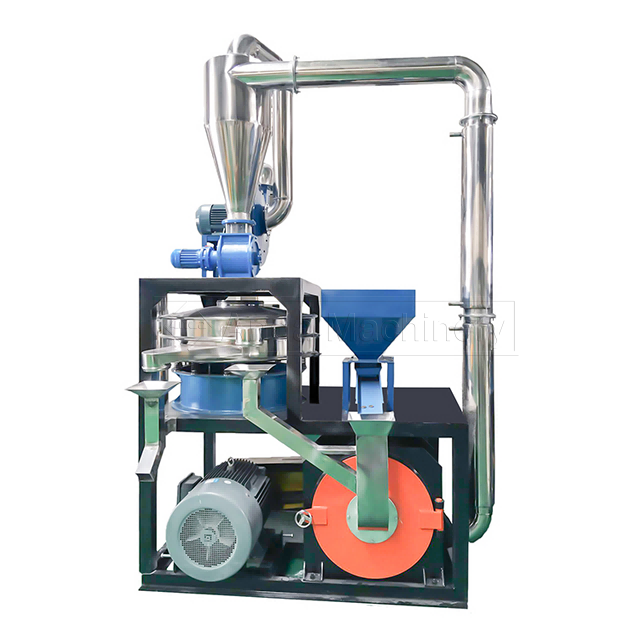
Selecting the right machine size requires accurate data on your daily scrap generation. Calculate your required throughput by dividing your total weekly scrap volume by your planned pulverizing operating hours. If you generate 5,000 kg of scrap per week and plan to run the mill for 10 hours a week, you need a machine capable of a true 500 kg/hr output.
Pay strict attention to specific energy consumption, measured in kWh/kg. This metric dictates your ongoing operational expenses. Never oversize the main motor just to have extra capacity. Electric motors operate most efficiently near their full rated load. Running a massive 1000 kg/hr pulverizer at only 30% capacity wastes enormous amounts of electricity, destroying the financial return on your recycling efforts. Match the motor size tightly to your actual production needs.
Polyvinyl Chloride is incredibly heat sensitive. Exceeding specific temperature thresholds causes catastrophic production problems. The material will burn, discolor, and degrade. Worse, burning PVC releases hydrochloric acid (HCl) gas. This gas poses severe respiratory hazards to operators and rapidly corrodes the steel components of the milling equipment, ducting, and downstream extruders.
Effective thermal management is non-negotiable. While some basic mills rely solely on air cooling, processing rigid PVC requires a dual-cooling approach. The industry standard utilizes a chilled water jacket surrounding the grinding chamber combined with an induced draft air system. The water jacket pulls heat away from the stationary stator, while the induced draft fan pulls ambient air through the milling chamber, cooling the material as it grinds and conveying it pneumatically to the cyclone.
Grinding plastic is not an exact science; a mill will always produce a mix of fine powder and slightly oversized flakes. You must control the final particle size distribution before the material reaches your extrusion silos. An integrated vibratory screen or rotary sifter is mandatory for quality control.
This sifter sits directly beneath the cyclone separator. It acts as a physical gatekeeper. Powder that meets your 20-30 mesh requirement passes through the screen and drops into the bagging station or pneumatic conveying line. Oversized particles are caught by the screen. A closed-loop pneumatic feedback mechanism immediately vacuums these oversized flakes and transports them back into the main grinding chamber for re-milling. This guarantees that no coarse material ever reaches your extruders to cause melt instability.
Wear parts dictate your maintenance schedule and machine uptime. The wear rate of grinding discs or turbine blades depends heavily on the calcium carbonate (CaCO3) filler content in your PVC scrap. High-filler pipes act like liquid sandpaper inside the milling chamber. They wear down standard steel blades rapidly. If you process high-filler scrap, you must specify hardened alloy discs, specialized heat treatments, or tungsten carbide coatings to extend the lifespan of your wear parts.
Evaluate machine designs based on maintenance access. When blades dull, throughput drops and friction heat spikes. You must change them quickly. Clamshell opening designs allow a single operator to unlatch and swing open the entire grinding chamber in minutes. Older designs rely on bolted faceplates that require heavy impact wrenches, hoists, and hours of labor just to expose the grinding discs. Choose designs that minimize maintenance downtime and reduce operator fatigue.
| Maintenance Task | Frequency | Action Required |
|---|---|---|
| Inspect Grinding Gap | Daily | Check clearance between rotor and stator. Adjust if throughput drops. |
| Check Water Cooling Flow | Daily | Verify chiller temperature and ensure no blockages in the water jacket. |
| Clean Rotary Sifter Screen | Weekly | Remove trapped oversized flakes to maintain proper powder classification. |
| Inspect Drive Belts | Monthly | Check for tension and wear. Replace if fraying occurs to prevent slippage. |
| Replace Grinding Discs | 500 - 1500 Hours | Swap out dull discs. Frequency depends heavily on CaCO3 filler content. |
A modern milling system is a precision instrument, not a crude grinder. Manual feeding relies on an operator staring at an amp meter and adjusting a dial. If they feed material too fast, the main motor overloads and trips the breaker, causing a massive jam that takes hours to clear. If they feed too slow, you lose throughput and waste electricity.
You need a PLC-based control system. The PLC automatically links the speed of the vibratory feeder to the amperage draw of the main grinding motor. If the main motor encounters a tough batch of material and the amps spike, the PLC instantly slows down the feeder. As the motor clears the load and amps drop, the feeder speeds back up. This closed-loop automation prevents material jamming, maximizes throughput, and ensures consistent powder quality without constant human supervision.
A complete pulverizing line requires significant physical space. You are not just installing a mill. You are installing the main grinding chamber, a massive cyclone separator, a rotary sifter, a pulse-jet baghouse, and the associated pneumatic ducting.
Evaluate your floor plan before purchasing. Vertical layout configurations stack the cyclone and sifter directly above the bagging station. This saves valuable floor space but requires high factory ceilings. Horizontal layouts spread the components across the floor, requiring less vertical clearance but consuming a larger footprint. Plan the installation to integrate smoothly into your existing extrusion facility without disrupting forklift traffic or current material handling workflows.
Tramp metal is the primary cause of catastrophic pulverizer failure. A single stray bolt, a dropped screw, or a piece of baling wire mixed into the scrap will shatter high-speed grinding discs instantly. This causes thousands of dollars in damage and halts your recycling operation for days while you wait for replacement parts.
You must mandate the inclusion of in-line magnetic separators. Install high-intensity drawer magnets or electronic metal detectors on the conveyor belt or pneumatic feed line immediately prior to the pulverizer inlet. This simple addition acts as a mandatory insurance policy for your grinding chamber.
Milling PVC generates ultrafine dust. If left unmanaged, this dust coats your factory floor, ruins nearby machinery bearings, and creates a severe respiratory hazard for your staff. Standard cloth filter bags are entirely inadequate for industrial milling operations.
You must install high-efficiency cyclone separators paired with pulse-jet baghouse dust collectors. The cyclone drops the heavy powder into the sifter, while the baghouse captures the microscopic airborne fines. Furthermore, enclosed milling environments present combustible dust explosion risks. Ensure your dust collection system complies with local ATEX or NFPA regulations, utilizing proper grounding, anti-static filter media, and explosion venting panels where required by local fire codes.
High-speed plastic pulverizers generate extreme noise levels. The sound of steel blades smashing rigid PVC at 3600 RPM often exceeds 90-100 decibels. Prolonged exposure causes permanent hearing damage to floor staff.
Do not install a bare machine in the middle of a quiet extrusion hall. Evaluate the necessity of soundproofing enclosures. Heavy-gauge steel cabinets lined with acoustic foam drastically reduce the decibel output. Install vibration-damping mounts under the machine frame to prevent low-frequency noise from traveling through the concrete floor. Enforce mandatory PPE, including industrial-grade ear protection, for all operators working near the equipment.
Integrating new recycling systems often creates friction with floor staff. Operators hate equipment that is difficult to calibrate. The most frustrating task on a traditional pulverizer is setting the gap between the grinding discs. Reaching inside a cramped, dirty chamber with feeler gauges to make micro-adjustments is a painful, time-consuming process.
You can overcome this learning curve by investing in modern equipment. Recommend pulverizers equipped with external gap adjustment dials. These systems allow the operator to turn a calibrated handwheel on the outside of the machine to tighten or loosen the grinding gap. This eliminates the pain of complex internal calibrations, reduces maintenance time from hours to minutes, and ensures operators actually perform the necessary adjustments to maintain powder quality.
Procurement managers must cut through marketing claims and focus on mechanical realities. Use this Boolean-style checklist when evaluating vendor quotes to ensure you are comparing equivalent industrial systems.
When you narrow down your vendor list, force the manufacturers to answer these top three questions during the quoting process:
An industrial pulverizer is not an optional accessory for modern extrusion facilities. It is a mandatory asset for achieving zero-waste manufacturing. By converting coarse, unusable regrind into a fine, 20-30 mesh powder, you protect your profit margins against volatile virgin resin prices and eliminate the extrusion instability caused by standard granulators.
When shortlisting equipment, match the technology to your specific operational reality. Choose disc pulverizers for standard rigid pipe scrap with moderate throughput needs, as they offer lower capital expenditure and simpler maintenance. Opt for turbo mills if you run high-volume, continuous-duty operations that demand maximum output and aggressive natural cooling.
A: The ideal size is typically 20-30 mesh, which translates to 500-800 microns. This specific particle size closely matches the bulk density of virgin PVC resin. Matching the mesh size ensures seamless blending, prevents hopper bridging, and maintains consistent melt pressure inside the extruder barrel.
A: Yes, it can easily process high-filler scrap. However, calcium carbonate (CaCO3) filler is highly abrasive. Processing this material requires hardened, wear-resistant grinding discs or tungsten carbide coatings. Standard steel blades will wear out rapidly, leading to increased maintenance costs and downtime.
A: PVC burns when it exceeds its thermal degradation point. This happens due to excessive friction heat inside the milling chamber. Inadequate water cooling, clogged airflow, or operating with dull grinding blades drastically increases internal temperatures. When PVC burns, it releases corrosive hydrochloric acid (HCl) gas.
A: The difference lies in the final particle size. Granulators use rotating knives to cut large plastic parts into 8-12mm coarse chips. Pulverizers take those chips and use friction or impact milling to grind them down into a sub-millimeter, fine powder suitable for direct extrusion.
A: Replacement intervals depend entirely on operating hours and material abrasiveness. For standard rigid PVC, discs typically last between 500 and 1500 hours. Processing scrap with high calcium carbonate filler will push that lifespan toward the lower end of the spectrum, requiring more frequent replacements.
A: Yes, a dedicated industrial water chiller is highly recommended. Tap water often lacks the consistent temperature required to cool the machine effectively. A chiller maintains the water jacket at an optimal temperature, preventing the PVC from overheating, degrading, or discoloring during the high-friction milling process.


