 English English

Views: 0 Author: Site Editor Publish Time: 2026-10-28 Origin: Site


PVC corner profile decoration uses hot stamping or film lamination to apply wood-grain, marble-effect, metallic, and other decorative finishes to extruded PVC corner profiles. Both methods can be integrated into compatible extrusion lines, but they differ in material transfer, surface coverage, equipment configuration, and production requirements.
Online hot stamping transfers decorative layers from a carrier foil using heat and pressure, while online lamination bonds a decorative film to the PVC profile using an appropriate adhesive system.
For manufacturers producing PVC corner strips, corner guards, and decorative profiles, understanding these differences helps improve surface appearance, edge coverage, adhesion, and production consistency.
Table of Contents
PVC corner profile decoration is a surface-finishing process used to improve the appearance of extruded plastic corner products.
Decorative corner profiles are commonly used in:
Interior wall corner protection.
Door frame and window trim decoration.
Decorative wall and ceiling panel finishing.
Furniture and cabinet edge applications.
Interior building renovation projects.
PVC corner profiles often contain narrow faces, sharp edges, or angled sections that require careful control during decoration.
Unlike flat decorative panels, corner profiles may require specially configured rollers to ensure that the foil or film contacts all intended surfaces.
The two main industrial methods are online hot stamping and online lamination.
Although both processes produce decorative surfaces, their working principles are different.

Comparison | Online Hot Stamping | Online Lamination |
|---|---|---|
Working principle | Transfers decorative layers using heat and pressure | Bonds a continuous decorative film |
Decorative material | Hot stamping foil | PVC, PET, or compatible decorative film |
Adhesive system | Usually incorporated into transfer foil | Separate or pre-applied adhesive system |
Carrier material | Removed after transfer | Decorative film remains on profile |
Equipment | Heated stamping roller and foil feeding system | Film feeding, adhesive application, wrapping rollers |
Profile coverage | Depends on roller shape and contact area | Can wrap multiple surfaces with suitable tooling |
Surface texture | Primarily determined by transferred coating | May include textured films |
Main process controls | Temperature, pressure, speed, tension | Adhesive, surface preparation, roller alignment, tension |
Common defects | Incomplete transfer, foil peeling, bridging | Wrinkling, bubbling, delamination |
Production integration | Suitable for compatible inline systems | Suitable for inline or offline wrapping configurations |
Neither process is universally better.
Hot stamping may be advantageous for selected decorative patterns and relatively simple contact geometries. Lamination may be more appropriate when continuous film coverage or textured finishes are required.
Online hot stamping transfers a decorative layer from a carrier foil onto the PVC profile using a heated roller and controlled pressure.
The process relies on the interaction between foil chemistry, contact temperature, pressure, and production speed.
The PVC compound passes through the extrusion system and forming die.
After calibration and suitable cooling, the profile must maintain consistent dimensions and surface quality.
Before decoration, check for dust, processing residues, scratches, and dimensional irregularities.
Install the decorative foil roll and guide it into the stamping area.
Adjust alignment and tension to maintain stable foil movement.
The foil orientation must match the machine and material supplier's requirements.
A heated stamping roller presses the foil against the PVC corner profile.
Heat activates the transfer mechanism, allowing the decorative layer to bond to the substrate.
Roller shape, pressure, and contact duration must be compatible with the corner profile geometry.
After the decorative layer transfers, the carrier film is removed according to the foil's release requirements.
The decorative pattern remains on the PVC surface.
Inspect the decorated surface for incomplete transfer, foil peeling, pattern distortion, and uncovered edges.
The profile can then continue through the appropriate cooling, cutting, or downstream handling stages.
For additional technical background, the hot foil stamping reference from HTWK Leipzig explains the roles of temperature, pressure, contact time, and carrier-layer release.
Online lamination, also called PVC profile wrapping, applies a continuous decorative film to the extruded profile.
Unlike hot stamping, the decorative film itself generally remains attached to the finished product.
Clean the profile to remove dust, oil, and processing residues.
Depending on the material and adhesive system, additional surface treatment or primer application may be required.
Install the selected film roll and adjust its position and tension.
Accurate alignment is especially important when the film must cover multiple faces of an angled corner profile.
The adhesive may be applied to the film or substrate, depending on the equipment and material system.
Compatible systems can include reactive polyurethane hot-melt adhesives and other formulations designed for profile wrapping.
Adhesive temperature, application weight, open time, and curing requirements should follow supplier specifications.
A series of wrapping rollers guides the decorative film onto the profile.
The rollers apply pressure sequentially to the required surfaces.
For angular profiles, the roller arrangement must provide sufficient contact at corners and edges.
After wrapping, the bond must achieve sufficient handling strength before downstream operations.
Some adhesive systems require additional time to develop full final bond strength.
Inspect the finished profile for wrinkles, bubbles, exposed edges, adhesive squeeze-out, and delamination.
Temperature, pressure, speed, and material tension directly influence the quality of decorated PVC corner profiles.
Hot stamping requires sufficient temperature to activate the foil transfer mechanism.
However, excessive heating may deform the PVC substrate or damage the foil.
For lamination, temperature requirements depend on the adhesive and decorative film.
There is no universal temperature suitable for all PVC corner profiles.
Manufacturers should verify the recommended process window with the foil or adhesive supplier and conduct production trials.
Uniform roller contact is essential for both processes.
Insufficient pressure can cause incomplete transfer or weak bonding.
Excessive pressure may deform the profile or damage the decorative layer.
For corner profiles, the roller shape is particularly important because the tool must follow the profile geometry.
The decoration stage must operate at a speed compatible with the upstream extrusion process.
Excessive speed may reduce contact time or interfere with adhesive application.
Low speed may expose heat-sensitive PVC profiles to excessive thermal energy.
Stable speed synchronization helps maintain consistent decorative quality.
Incorrect web tension can cause:
Wrinkling.
Pattern distortion.
Film stretching.
Lateral movement.
Carrier film breakage.
The feeding system should maintain stable alignment without applying unnecessary tension.
The extruded profile must have a sufficiently clean and consistent surface.
Dust, oil, dimensional variation, and inadequate surface preparation may interfere with decorative transfer or adhesive bonding.
PVC corner profile decoration presents unique challenges because the decorative material must follow narrow, angled, or irregular surfaces.
Defect | Main Causes | Recommended Solutions |
|---|---|---|
Incomplete hot stamping | Insufficient temperature, pressure, or contact | Verify roller conditions and foil compatibility |
Edge bridging | Incorrect roller geometry, insufficient contact | Adjust or replace profile-specific rollers |
Foil peeling | Contamination, incompatible foil, inadequate transfer | Improve cleaning and verify processing conditions |
Film wrinkling | Uneven tension, roller misalignment | Adjust film feeding and wrapping rollers |
Air bubbles | Trapped air, contamination, uneven adhesive application | Improve surface preparation and bonding |
Lamination delamination | Incompatible adhesive, insufficient bonding | Verify material compatibility and curing |
Pattern distortion | Excessive heat or film tension | Adjust temperature, speed, and tension |
Profile deformation | Excessive thermal or mechanical stress | Reduce unsuitable heat or pressure |
Adhesive squeeze-out | Excessive adhesive application or pressure | Adjust coating weight and wrapping conditions |
Incomplete transfer at the edges may occur when the stamping roller does not follow the profile geometry accurately.
The foil may contact the flat surfaces while failing to transfer onto narrow edges or angled sections.
Inspect the stamping roller shape, alignment, pressure distribution, and profile dimensions.
A roller specifically designed for the corner profile geometry can improve contact consistency.
Film wrinkles may develop because of excessive tension, incorrect web alignment, or poorly positioned wrapping rollers.
The problem can become more noticeable when the film bends around sharp corners.
Check that the wrapping rollers guide the film progressively without stretching or folding it excessively.
Peeling may result from poor substrate preparation, unsuitable adhesive chemistry, insufficient bonding conditions, or premature handling.
For reactive adhesive systems, the final bond strength may continue developing after initial application.
Manufacturers should evaluate adhesion after the adhesive has reached its specified cure condition.
Avoid exposing the profile to excessive heating or mechanical pressure.
Verify that the extruded profile has sufficient dimensional stability before the decoration stage.
Adjust the process according to the PVC formulation, geometry, and thermal characteristics.
Both hot stamping and lamination support a variety of decorative finishes.
The available results depend on the selected foil or film and its compatibility with the profile.
Wood-grain decorative finishes are commonly used to coordinate corner profiles with doors, wall panels, furniture, and other interior decorative materials.
Possible patterns include oak, walnut, teak, and other timber-effect designs.
Marble and stone patterns are suitable for decorative wall corners and compatible interior finishing systems.
These finishes can help visually coordinate corner accessories with marble-effect wall panels.
Solid color films provide uniform decorative appearances.
Metallic hot stamping foils may be used where reflective decorative effects are required.
Lamination can provide decorative films with textured surfaces.
The final texture and performance depend on the film construction and wrapping conditions.
Online decoration equipment must work together with the extrusion line rather than operate as an isolated process.
Important considerations include profile geometry, production speed, substrate temperature, available factory space, and finished product requirements.
A suitable PVC Corner Production Line provides the upstream extrusion and forming equipment for compatible corner profiles.
Consistent extrusion quality helps maintain accurate profile dimensions before decorative finishing.
The corner profile should be sufficiently stable before entering the decoration stage.
Excessive residual heat or dimensional instability can affect hot stamping or film bonding.
Cooling arrangements must be coordinated with the decoration process.
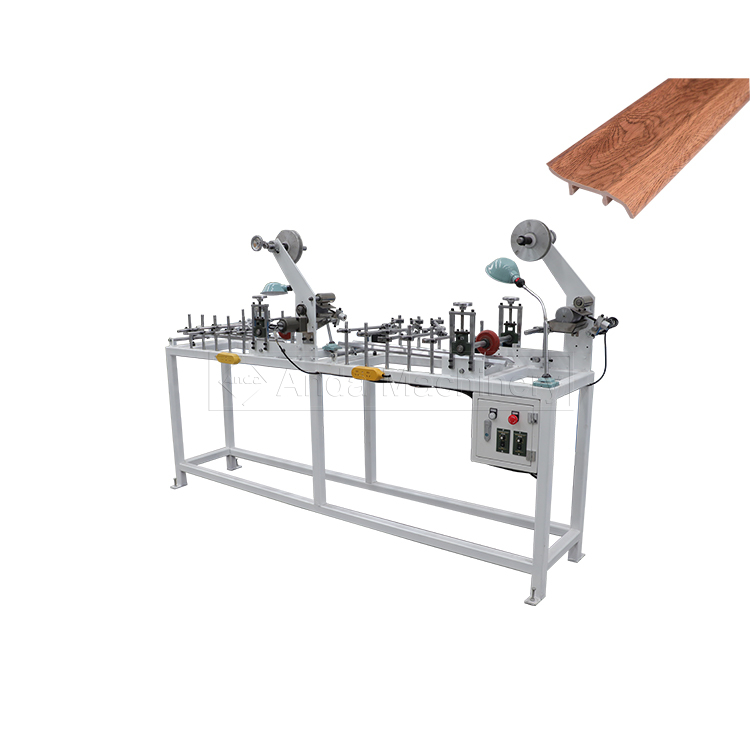
ANDA offers Online Hot Stamping and Lamination for Corner Clip equipment for compatible corner profile finishing applications.
Equipment configuration should be evaluated according to the required finishing process, profile geometry, decorative material, and production capacity.
After decoration, profiles may require further stabilization before cutting, stacking, or packaging.
The downstream equipment should maintain consistent material movement and protect the finished decorative surface.
Quality inspection should cover substrate preparation, process stability, decorative appearance, and finished product performance.
Inspection Stage | Quality Check |
|---|---|
Before decoration | Profile dimensions, cleanliness, surface condition |
Hot stamping | Foil alignment, roller temperature, contact uniformity |
Lamination | Adhesive application, film tension, wrapping contact |
After decoration | Surface coverage, wrinkles, bubbles, edge appearance |
Finished profile | Adhesion, dimensional stability, visual consistency |
Corner profiles may have surfaces that are difficult to decorate uniformly.
Check whether the decorative material reaches the required edges without gaps or distortion.
Perform suitable adhesion tests based on the coating or film construction and intended application.
Testing methods should be agreed with the material supplier and matched to the finished product.
Maintain production records for important settings, material batches, and inspection results.
These records support troubleshooting and process repeatability.
ANDA Machinery supplies PVC extrusion equipment and related surface-finishing solutions for plastic decorative products.
For PVC corner profile projects, the equipment configuration can be evaluated based on:
PVC compound and profile dimensions.
Required decorative coverage.
Hot stamping or lamination process.
Decorative foil or film specifications.
Target extrusion and decoration speed.
Available production space.
Required downstream operations.
Manufacturers developing other decorative products can also explore ANDA's Surface Finishing Machine category for additional equipment applications.
For production projects involving decorative PVC sheets rather than narrow corner profiles, the PVC Laminate Production Line provides another relevant example of combining extrusion with downstream finishing processes.

Online hot stamping is a process that transfers decorative layers from a carrier foil onto an extruded PVC profile using controlled heat, pressure, and contact time.
Hot stamping transfers decorative layers from a carrier foil, while lamination attaches a continuous decorative film to the profile using an appropriate adhesive system.
Yes, compatible online equipment can be integrated with extrusion production. However, substrate cooling, dimensional stability, line speed, and material compatibility must be considered.
Common causes include insufficient transfer temperature, poor surface cleaning, incompatible foil chemistry, inadequate roller contact, and unsuitable processing conditions.
Yes, suitable film-wrapping equipment can cover angled surfaces, provided the film, adhesive, roller arrangement, and profile geometry are compatible.
Common options include wood grain, marble effects, solid colors, metallic finishes, and selected textured designs.
Bubbles may result from substrate contamination, trapped air, uneven adhesive application, or insufficient contact pressure during wrapping.
Not necessarily. Actual production speed depends on equipment design, decorative materials, profile geometry, and process requirements. The decoration stage must operate consistently with the extrusion line.
PVC corner profile decoration can be achieved through online hot stamping or lamination, depending on the decorative finish, substrate geometry, and production requirements.
Hot stamping transfers decorative layers using heat and pressure, while lamination bonds a continuous decorative film to the profile.
Both methods require careful control of material compatibility, temperature, contact pressure, production speed, and surface quality.
For manufacturers planning a new PVC corner profile line or upgrading an existing production system, integrating appropriate decoration equipment can improve surface consistency and support a wider range of decorative products.
Looking for PVC Corner Profile Decoration Equipment?
ANDA Machinery provides PVC profile extrusion and compatible decoration equipment solutions.
Contact ANDA Machinery to discuss your corner profile dimensions, decorative finishes, target capacity, and production line requirements.


