 English English

Views: 0 Author: Site Editor Publish Time: 2026-10-28 Origin: Site


PVC fluted wall panel lamination is an industrial surface finishing process that bonds decorative films to extruded PVC panels with raised ribs and recessed grooves. The process typically involves surface preparation, film feeding, adhesive application, profile wrapping, and finished panel inspection.
Unlike flat panel lamination, PVC fluted panel lamination requires precise control of film tension, adhesive distribution, and wrapping roller contact. These factors help the decorative film follow the panel's three-dimensional profile without wrinkles, bubbles, film misalignment, or incomplete bonding.
This guide explains how the PVC fluted wall panel lamination process works, its main production steps, important machine settings, common defects, and practical solutions for decorative panel manufacturers.
Table of Contents
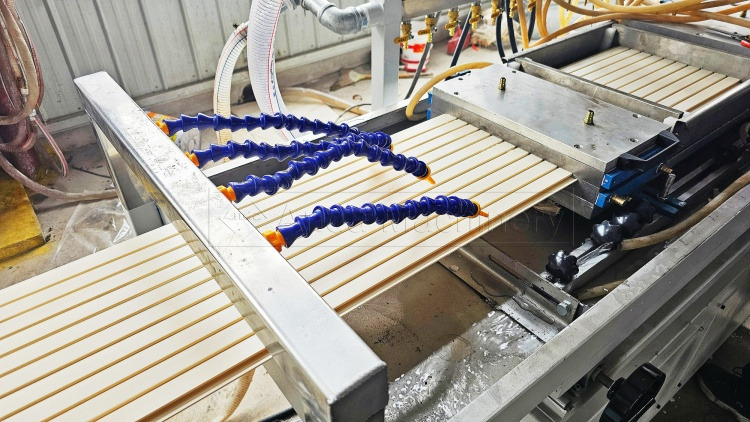
PVC fluted wall panel lamination is a manufacturing process used to apply decorative films to PVC wall panels featuring parallel raised ribs and recessed grooves.
The decorative film is bonded to the panel surface using a compatible adhesive system and a series of pressure rollers. Depending on production requirements, manufacturers may use cold glue or PUR hot-melt adhesive systems.
Common decorative finishes include:
Wood grain patterns
Marble and stone effects
Solid colors
Matte finishes
Metallic-effect designs
Textured decorative films
The purpose of lamination is to create a consistent decorative surface while maintaining the original fluted panel geometry.
Unlike wall panel installation, which involves attaching finished panels to walls, industrial lamination is performed during the panel manufacturing or surface finishing stage.
Flat panels have relatively uniform surfaces, allowing decorative films to be bonded using conventional pressure rollers.
Fluted panels contain repeated grooves, corners, and raised surfaces. The film must follow these contours without stretching excessively or trapping air.
Three factors make the process more demanding:
1. Complex surface geometry
The film must conform to raised ribs, groove walls, and recessed areas.
2. Uneven pressure distribution
Conventional flat rollers may not provide sufficient contact inside narrow or deep grooves.
3. Film tension and alignment
Incorrect tension or tracking can cause wrinkles, distorted patterns, or lateral film movement.
For consistent results, manufacturers need a suitable adhesive system, compatible decorative film, and profile-specific wrapping rollers.
A PVC fluted wall panel lamination machine applies decorative film to the surface of an extruded PVC panel through coordinated film feeding, adhesive application, and roller wrapping.
The decorative film is unwound and guided toward the moving panel. A compatible adhesive is applied to the film or substrate according to the selected bonding system.
The panel and film then pass through a series of pressure rollers. These rollers are arranged to establish contact across the raised surfaces, groove walls, and recessed areas.
After wrapping, the laminated panel moves to downstream handling and inspection.
Machine Component | Main Function |
|---|---|
Film Unwinding Unit | Supplies decorative film continuously |
Film Guiding System | Maintains film alignment and tracking |
Adhesive Application Unit | Applies a controlled adhesive layer |
Profile Wrapping Rollers | Press film onto raised and recessed surfaces |
Panel Conveying System | Maintains stable substrate movement |
Control System | Coordinates machine operation and process settings |
Downstream Handling Unit | Transfers finished panels for inspection and further processing |
The exact machine configuration depends on panel width, groove depth, decorative film material, adhesive type, and required production capacity.
For example, an Online Lamination Machine for PVC Wall Panel & PVC Fluted Panel can support decorative finishing in a compatible panel manufacturing arrangement.

A typical PVC fluted wall panel lamination process consists of six stages, from substrate preparation to finished panel inspection.
Each stage affects surface appearance, film adhesion, and production consistency.
Before lamination, inspect the extruded PVC panel for surface contamination, deformation, and dimensional inconsistencies.
Dust, oil, processing residues, and loose particles can interfere with adhesive bonding.
Pay particular attention to recessed grooves, where contamination may be difficult to remove.
Key operations:
Clean the panel surface.
Remove dust and processing residues.
Inspect groove dimensions and surface condition.
Check panel flatness and dimensional stability.
Verify compatibility with the selected adhesive.
Some PVC formulations may require additional surface treatment or primer to achieve suitable adhesion.
Install the decorative film roll on the unwinding unit.
Position the film according to the required coverage width and panel centerline.
Verify the winding direction, roll condition, and decorative pattern orientation.
Incorrect film positioning can cause uneven coverage or pattern misalignment during wrapping.
Key operations:
Position the decorative film roll.
Align the film with the PVC panel.
Check the unwinding direction.
Adjust initial film tension.
Inspect the film for wrinkles or edge damage.
Film tension must remain stable throughout the lamination process.
Excessive tension may stretch the decorative film, distort printed patterns, or cause the film to lift from recessed grooves.
Insufficient tension may create slack, resulting in wrinkles and folds.
The film feeding speed must also remain coordinated with the panel conveying speed.
Key operations:
Establish stable unwinding tension.
Check film tracking.
Synchronize film and panel movement.
Avoid sudden speed changes.
Verify that the film does not stretch excessively.
The appropriate tension depends on film material, thickness, flexibility, and production conditions.
The adhesive provides the bond between the decorative film and PVC substrate.
Depending on the equipment configuration, adhesive may be applied to the film or panel.
Cold glue and PUR hot-melt systems require different processing conditions.
Key operations:
Verify adhesive compatibility.
Set the required application conditions.
Maintain uniform adhesive distribution.
Avoid excessive adhesive accumulation.
Check adhesive open time and wetting behavior.
Excess adhesive may cause squeeze-out or pooling, while insufficient adhesive may result in weak bonding or delamination.
The decorative film passes through a series of profile-specific wrapping rollers.
These rollers apply pressure to the intended bonding surfaces, helping the film conform to the panel geometry.
Roller positions must be adjusted according to groove depth, rib width, film flexibility, and adhesive behavior.
Key operations:
Establish initial film contact.
Apply progressive pressure across the profile.
Guide the film along groove walls.
Ensure contact inside recessed areas.
Inspect for trapped air, wrinkles, and film bridging.
The wrapping sequence should be adapted to the actual panel geometry rather than relying on one universal roller arrangement.
After wrapping, the adhesive bond must develop under the conditions specified by the adhesive supplier.
The finished panel should be inspected for appearance and adhesion before further processing or packaging.
Key inspection items:
Decorative pattern alignment
Wrinkles and surface folds
Air bubbles
Complete groove coverage
Edge adhesion
Surface scratches
Local film separation
Avoid excessive handling or stacking pressure before the adhesive reaches sufficient handling strength.
Stable lamination quality depends on controlling several interconnected production parameters.
The correct settings should be established through controlled trials using the actual PVC panel, decorative film, and adhesive.
Parameter | Main Function | Risk of Incorrect Settings |
|---|---|---|
Film Tension | Maintains stable film feeding | Wrinkles, stretching, pattern distortion |
Roller Pressure | Establishes film-to-panel contact | Weak bonding or panel deformation |
Adhesive Coating Weight | Provides sufficient bonding material | Delamination or adhesive pooling |
Production Speed | Coordinates process stages | Unstable wrapping or insufficient bonding time |
Adhesive Temperature | Maintains suitable application conditions | Poor flow or adhesive degradation |
Roller Alignment | Maintains consistent profile contact | Uneven wrapping and film movement |
Film Flexibility | Allows film to follow groove geometry | Bridging, lifting, or cracking |
Film tension should be sufficient to maintain stable feeding without stretching the decorative material.
Thin films and highly flexible films may respond differently to tension changes.
Operators should check both the unwinding section and the wrapping section when diagnosing tension-related defects.
Roller pressure must be sufficient to establish contact between the decorative film and the intended substrate surfaces.
Excessive pressure may distort the film or deform the PVC panel.
Insufficient pressure can lead to incomplete bonding, particularly inside recessed grooves.
Roller geometry, hardness, and position should be matched to the panel profile.
Adhesive coating weight should follow the adhesive supplier's recommendations and be verified through production trials.
The appropriate amount depends on substrate characteristics, film construction, adhesive chemistry, and application method.
Production speed affects the available time for adhesive application, film positioning, and wrapping.
Film feeding and panel conveying should remain synchronized.
The fastest possible line speed is not necessarily the most effective operating condition if it increases defects or material waste.
Environmental conditions can affect adhesive behavior.
For water-based adhesive systems, drying conditions may be important.
For reactive PUR systems, adhesive temperature and moisture exposure require appropriate control.
Common defects include wrinkles, film misalignment, bubbles, film bridging, delamination, and edge lifting.
These problems are usually related to film feeding, substrate condition, adhesive application, wrapping roller contact, or material compatibility.
Defect | Possible Causes | Recommended Solutions |
|---|---|---|
Diagonal wrinkles | Uneven tension, skewed feeding | Adjust film tension and alignment |
Longitudinal wrinkles | Excess film, incorrect roller contact | Adjust roller sequence and pressure |
Film misalignment | Incorrect guiding, unstable feeding | Realign film and substrate |
Air bubbles | Trapped air, contamination | Improve cleaning and progressive contact |
Film bridging | Inadequate groove contact | Adjust wrapping rollers |
Delamination | Poor adhesion or incompatible materials | Verify surface preparation and adhesive |
Edge lifting | Insufficient edge contact | Inspect edge rollers and bonding conditions |
Pattern distortion | Excessive stretching | Reduce unsuitable film tension |
Wrinkles form when the decorative film cannot move or conform uniformly during wrapping.
Diagonal wrinkles often indicate uneven film tension, incorrect alignment, or skewed feeding.
Longitudinal wrinkles may develop when excess film accumulates along the panel profile or when rollers distribute pressure unevenly.
Wrinkles inside grooves may result from unsuitable film flexibility or incorrect roller contact.
To reduce wrinkles:
Maintain stable film tension.
Inspect film and panel alignment.
Check wrapping roller positions.
Avoid excessive stretching.
Verify film compatibility with the groove geometry.
When troubleshooting, identify where the wrinkle first appears before changing machine settings.
Film misalignment occurs when the decorative film shifts sideways relative to the PVC panel.
It can cause uneven decorative coverage, exposed substrate edges, and distorted printed patterns.
Common causes include:
Incorrect film roll positioning
Uneven unwinding tension
Misaligned guide rollers
Skewed panel feeding
Unstable production speed
Recommended solutions:
First, check the film roll position and the panel conveying centerline.
Next, inspect guide rollers and verify that the film enters the wrapping section without lateral movement.
Finally, coordinate film feeding and panel conveying speed to maintain consistent tracking.
Air bubbles develop when air becomes trapped between the decorative film and substrate.
Film bridging occurs when the film spans a recessed groove without contacting the intended bonding surfaces.
These defects may be caused by:
Inadequate surface cleaning
Uneven adhesive distribution
Incorrect wrapping roller positions
Insufficient groove contact
Unsuitable decorative film flexibility
Recommended solutions:
Improve surface preparation and verify adhesive application.
Inspect the wrapping sequence to determine whether air is being trapped.
For deep grooves, confirm that the film and roller configuration are suitable for the required profile geometry.
Delamination occurs when the decorative film separates from the PVC substrate.
Edge lifting is a localized form of separation near the panel edges or profile transitions.
Possible causes include:
Contaminated substrate surfaces
Incompatible adhesive and film materials
Inadequate bonding pressure
Incorrect adhesive application
Insufficient bond development
Excessive stress on wrapped edges
Recommended solutions:
Verify surface cleanliness and material compatibility before increasing roller pressure.
Inspect adhesive application conditions and confirm that finished samples are evaluated after the required bonding period.
Cold glue and PUR hot-melt lamination are two adhesive approaches used in decorative panel finishing.
Both can be suitable for compatible PVC fluted wall panels, but their processing requirements differ.
Comparison | Cold Glue Lamination | PUR Hot-Melt Lamination |
|---|---|---|
Adhesive type | Cold-applied compatible adhesive | Reactive polyurethane hot-melt adhesive |
Application temperature | Depends on formulation | Requires controlled heating |
Bond development | Depends on drying and adhesive chemistry | Initial setting through cooling, followed by chemical curing |
Main process considerations | Drying, open time, humidity | Temperature, moisture, open time |
Equipment requirements | Adhesive coating and wrapping | PUR melting, coating, and wrapping |
Common problems | Incomplete drying, weak adhesion | Incorrect application temperature, premature curing |
Suitable substrates | Depends on adhesive compatibility | Depends on adhesive compatibility |
Cold glue lamination uses an adhesive system that can be applied without the elevated processing temperatures associated with PUR hot-melt systems.
The method may be suitable for decorative film applications where the selected adhesive provides adequate bonding and drying performance.
ANDA's FM Series Cold Glue PVC Fluted Wall Panel Lamination Machine is an equipment option for compatible decorative panel finishing applications.

PUR lamination uses a reactive polyurethane hot-melt adhesive.
The adhesive is applied under controlled heating conditions and develops bond strength through cooling and subsequent chemical reaction.
PUR systems require appropriate adhesive handling, temperature control, and maintenance procedures.
ANDA's PUR Hot Glue Lamination Machine provides an alternative for compatible film bonding applications.

The preferred adhesive system depends on:
PVC substrate formulation
Decorative film material
Required adhesion performance
Groove geometry
Production speed
Operating environment
Equipment configuration
Manufacturers should evaluate actual material combinations through production trials rather than assuming that one adhesive system is universally better.
ANDA Machinery provides equipment for decorative panel extrusion and surface finishing applications.
The appropriate equipment configuration depends on the panel profile, decorative film, adhesive system, and production requirements.
Cold glue lamination equipment is used to apply compatible decorative films using suitable adhesive coating and wrapping systems.
For PVC fluted wall panels, roller positioning and film alignment are particularly important because the decorative material must follow repeated raised and recessed surfaces.
Online lamination systems can be incorporated into compatible panel manufacturing arrangements.
Their integration requires coordination between substrate production, panel conveying, adhesive application, and film wrapping.
The suitability of online lamination depends on the panel condition, required production speed, and equipment configuration.
A consistent substrate is essential for reliable lamination.
The SJSZ65/132 PVC Fluted Panel Production Line produces fluted PVC panels through extrusion and downstream shaping operations.
Stable panel dimensions, consistent groove geometry, and appropriate surface condition help support subsequent decorative finishing.
For related decorative profile manufacturing applications, ANDA also provides a WPC Louver Panels Wall Panel Making Machine.
When discussing a lamination project, manufacturers should provide:
PVC panel width and thickness
Groove depth and profile drawing
Decorative film material and thickness
Required surface finish
Preferred adhesive system
Target production capacity
Existing extrusion or finishing equipment
These details help determine the appropriate wrapping arrangement and machine configuration.
Quality control should cover substrate preparation, film feeding, adhesive application, wrapping, and finished panel inspection.
Production Stage | Quality Control Items |
|---|---|
PVC Substrate | Cleanliness, groove dimensions, panel flatness |
Decorative Film | Roll condition, alignment, tension |
Adhesive Application | Coating uniformity, compatibility, application conditions |
Wrapping Section | Roller contact, groove coverage, trapped air |
Bond Development | Required drying or curing conditions |
Finished Panel | Wrinkles, bubbles, adhesion, edge lifting, pattern alignment |
Check the decorative pattern for wrinkles, bubbles, scratches, and inconsistent coverage.
Inspect both raised surfaces and recessed grooves.
Evaluate adhesion using an appropriate method for the selected film, adhesive, and substrate.
Testing should be performed after the bonding system reaches the required condition.
For wood-grain or directional decorative films, verify that the printed pattern remains consistent along the panel length.
Maintain records of approved operating conditions, including film tension, adhesive application, line speed, and roller configuration.
Consistent documentation helps manufacturers reproduce successful production results and identify the causes of recurring defects.
PVC fluted wall panel lamination is a manufacturing process that bonds decorative film to extruded PVC panels with raised ribs and recessed grooves using a compatible adhesive and wrapping roller system.
The machine feeds decorative film toward a moving PVC panel, applies a compatible adhesive, and uses pressure rollers to bond the film to the panel's profile.
Compatible PVC, PET, PP, and other decorative films may be used, depending on the adhesive system, film flexibility, and equipment configuration.
Wrinkles commonly result from uneven film tension, incorrect alignment, unsuitable roller contact, or insufficient film flexibility.
Maintain correct film roll positioning, align the substrate feeding system, inspect guide rollers, and coordinate film and panel movement.
Film lifting may result from insufficient roller contact, poor adhesive bonding, unsuitable film flexibility, or incorrect wrapping conditions.
Yes. Compatible online lamination equipment can be integrated into suitable panel manufacturing arrangements when substrate stability, line speed, and finishing conditions are properly coordinated.
Cold glue lamination uses a compatible cold-applied adhesive system, while PUR lamination uses reactive polyurethane hot-melt adhesive. The two methods have different application and bond-development requirements.
Important factors include substrate cleanliness, decorative film flexibility, film tension, adhesive compatibility, wrapping roller contact, production speed, and environmental conditions.
The PVC fluted wall panel lamination process requires coordinated control of decorative film feeding, adhesive application, profile wrapping, and quality inspection.
Unlike flat panel lamination, fluted panel finishing must accommodate raised ribs and recessed grooves while maintaining consistent film alignment and bonding.
Common defects such as wrinkles, bubbles, film misalignment, and delamination can often be reduced through suitable material selection, correct machine configuration, and systematic process troubleshooting.
For decorative panel manufacturers, consistent substrate quality and reliable lamination equipment are essential for stable production.
Looking for a PVC Fluted Wall Panel Lamination Machine?
ANDA Machinery provides cold glue, PUR, and online lamination equipment for compatible decorative panel manufacturing applications.
Contact ANDA Machinery with your panel dimensions, groove profile, decorative film specifications, and production requirements to discuss a suitable lamination solution.


