 English English

Views: 0 Author: Site Editor Publish Time: 2026-10-28 Origin: Site


PVC dry blend mixing problems such as powder lumps, poor flowability, yellowing, uneven additive dispersion, and inconsistent bulk density can affect extrusion stability and finished product quality. These problems often originate from incorrect mixing temperatures, insufficient cooling, inaccurate ingredient dosing, or inconsistent material handling.
A properly prepared PVC dry blend should have a uniform composition, suitable flowability, and consistent properties from batch to batch. When these characteristics change, manufacturers may experience unstable extruder feeding, color variation, surface defects, or unnecessary production interruptions.
This guide covers seven common PVC dry blend mixing problems, their possible causes, practical troubleshooting methods, and ways to improve mixing consistency in PVC pipe, profile, sheet, and wall panel production.
Table of Contents
Before adjusting the PVC mixer, identify the visible symptom and determine whether the problem begins during mixing, cooling, storage, or extrusion.
The following troubleshooting table provides a starting point.
Mixing Problem | Common Symptoms | Possible Causes | First Checks |
|---|---|---|---|
Powder lumps and agglomeration | Hard particles, sticky powder, clogged screens | Insufficient cooling, excessive temperature, incorrect liquid addition | Cooling discharge temperature, ingredient feeding |
Poor powder flowability | Hopper bridging, inconsistent feeding | Moisture, caking, unsuitable additive distribution | Flow test, powder condition, moisture |
Bulk density variation | Changing powder density, unstable feeder output | Dosing errors, raw material changes, inconsistent mixing | Batch weight, bulk density, mixing records |
Yellowing and discoloration | Yellow, pink, or dark powder | Excessive heat exposure, stabilizer imbalance, contamination | Discharge temperature, stabilizer dosage, mixer cleanliness |
Uneven additive dispersion | Color streaks, inconsistent product properties | Incorrect addition sequence, insufficient mixing | Ingredient distribution, blade condition |
Moisture-related problems | Damp powder, agglomerates, possible extrusion bubbles | Wet raw materials, condensation, inadequate moisture control | Material storage, filler moisture, ventilation |
Batch-to-batch inconsistency | Different flow, color, or extrusion behavior | Dosing variation, inconsistent mixing and cooling | Batch records, weighing accuracy, temperature trends |
Important: A defect observed in the extruded product does not automatically mean that the dry blend is defective. Extruder temperature, screw design, material residence time, and tooling conditions must also be considered.
PVC dry blend preparation typically involves two connected stages: high-speed hot mixing and low-speed cooling.
The objective is to combine PVC resin with stabilizers, lubricants, fillers, pigments, processing aids, and other required additives to produce a consistent powder blend for subsequent processing.
During hot mixing, rotating blades create material movement and frictional heating.
The process helps distribute additives throughout the PVC resin and supports the absorption or coating behavior of certain formulation ingredients.
A typical hot mixing sequence includes:
Loading PVC resin and selected ingredients.
Starting the high-speed mixing cycle.
Adding remaining ingredients according to the approved formulation sequence.
Monitoring material temperature and mixing behavior.
Discharging the blend at the validated process endpoint.
The correct discharge temperature depends on the PVC formulation, mixer design, ingredient properties, and production requirements.
Reaching a target temperature alone does not guarantee that every additive has been distributed correctly.
After hot mixing, the material is transferred to a cooling mixer.
The cooling stage reduces residual heat, helps limit caking during storage, and prepares the powder for conveying or extrusion feeding.
If the blend remains too warm, it may become more prone to agglomeration or inconsistent handling.
Cooling performance depends on the cooling mixer design, water temperature, circulation conditions, batch size, and material properties.
Hot Mixing | Cold Mixing |
|---|---|
Distributes formulation ingredients | Removes excess heat |
Promotes controlled temperature increase | Reduces the risk of heat-related caking |
Supports suitable additive distribution | Helps stabilize powder handling conditions |
Prepares a uniform formulation blend | Prepares material for storage or feeding |
PVC dry blending is not the same as PVC melt processing. The main melting, fusion, and plasticization behavior occurs during subsequent processing, such as extrusion.

Lumps are among the most visible PVC powder mixing problems.
They may appear as small clusters, sticky particles, or larger hardened pieces that remain after mixing or storage.
Visible powder clumps after cooling
Material sticking to the mixer wall
Agglomerates in storage containers
Poor discharge from hoppers
Large particles retained during screening
Insufficient cooling: The powder is transferred or stored before enough heat has been removed.
Excessive hot mixing temperature: Unnecessary heat exposure may encourage undesirable softening or sticking of certain formulation components.
Incorrect liquid additive feeding: Adding liquid ingredients too quickly or unevenly may create localized wet areas.
Material buildup inside the mixer: Deposits on the vessel wall or discharge area may detach and contaminate later batches.
Moisture exposure: Damp materials can develop agglomerates during handling and storage.
Check the actual powder temperature at the cooling mixer discharge.
Verify cooling water temperature and circulation.
Review the hot mixing endpoint.
Inspect liquid additive feeding and distribution.
Clean accumulated material from approved access points.
Check mixer blade condition and clearances according to the manufacturer's maintenance instructions.
Evaluate storage conditions if caking occurs after mixing.
Troubleshooting tip: If the powder is free-flowing immediately after cooling but develops lumps during storage, investigate storage temperature, condensation, and moisture exposure before changing the hot mixing process.
Poor flowability occurs when the PVC dry blend does not move consistently through hoppers, feeding systems, or conveying equipment.
This can cause unstable material supply to the extruder.
Powder bridging inside the feeding hopper
Irregular discharge from storage containers
Fluctuating feeder output
Material sticking to conveying surfaces
Unstable extruder feeding
Poor powder flow may be associated with:
Excessive powder moisture
Agglomeration or caking
Inconsistent lubricant or liquid additive distribution
Inadequate cooling
Changes in powder particle characteristics
Unsuitable hopper or feeding equipment geometry
Check the powder condition. Determine whether the material contains visible lumps, moisture, or sticky particles.
Measure flowability consistently. Use a suitable, repeatable powder flow test and compare results against an approved reference batch.
Review the cooling process. Verify that the powder is discharged under suitable handling conditions.
Inspect ingredient addition. Confirm that liquid additives and lubricants are introduced according to the validated formulation procedure.
Check the feeding equipment. Bridging can also result from hopper design, outlet dimensions, or feeder configuration.
Do not assume that increasing mixer speed will resolve a powder flow problem. First identify whether the cause is material-related or equipment-related.
Bulk density describes the mass of powder occupying a given bulk volume.
It is an important quality indicator because changes in bulk density can influence storage behavior, volumetric feeding, and material handling.
Bulk density differs between production batches.
Volumetric feeder output changes unexpectedly.
Powder behavior varies despite using the same nominal formulation.
Extruder feeding becomes less consistent.
Bulk density variation may result from:
Changes in PVC resin grade or supplier batch
Incorrect filler or additive dosage
Different powder particle-size distributions
Changes in mixing conditions
Differences in material handling or compaction
Inconsistent sampling and measurement methods
Measure bulk density using the same test procedure for every comparison.
Verify actual batch weights and formulation records.
Compare PVC resin and filler specifications.
Review hot mixing temperature and batch duration.
Inspect the mixer for abnormal mechanical wear.
Compare results with an approved production baseline.
Bulk density is a useful process indicator, but it should not be treated as a direct or universal measurement of additive absorption.
For example, an increase in filler content can change bulk density without indicating that the mixing process has improved.
Best practice: Record bulk density together with batch weight, mixing time, discharge temperature, and raw material lot numbers.
Yellowing or unexpected color changes can indicate excessive thermal exposure, formulation differences, or contamination.
However, discoloration may also occur during extrusion even when the dry blend appears normal.
Yellowish or darker powder after hot mixing
Uneven color between batches
Visible dark particles in the dry blend
Color changes during subsequent extrusion
Excessive thermal exposure: The powder may remain at elevated temperatures longer than intended.
Incorrect stabilizer dosage: The formulation may not provide the required thermal stability.
Material buildup: Residual material exposed to repeated heating cycles can discolor and enter subsequent batches.
Ingredient contamination: Unwanted material may affect powder appearance.
Raw material variation: Changes in resin, filler, or pigment quality can affect color consistency.
Verify hot mixer temperature measurement accuracy.
Review discharge temperature and residence time.
Confirm stabilizer weighing and addition procedures.
Inspect the mixing chamber for retained material.
Compare raw material lots.
Test dry blend samples under controlled conditions.
Compare the color of the dry blend before extrusion with the finished product.
If discoloration is already present in the powder, investigate the mixing process, formulation, and raw materials.
If the dry blend appears normal but the extruded product changes color, examine extrusion temperatures, residence time, screw condition, and other processing variables.
This comparison helps prevent unnecessary mixer adjustments.
Uniform additive distribution is essential for consistent PVC processing and finished product appearance.
Poor dispersion may affect pigments, stabilizers, fillers, lubricants, and processing aids.
Uneven powder color
Visible pigment clusters
Inconsistent processing behavior
Variation in finished product appearance
Different performance between batches
Incorrect ingredient addition sequence
Insufficient mixing intensity or duration
Inaccurate dosing
Excessive mixer loading
Poor distribution of small-quantity additives
Worn or incorrectly configured mixing blades
Review the formulation sequence. Confirm that ingredients are added in the order recommended by the formulation or additive supplier.
Verify dosing accuracy. Small-quantity ingredients require particular attention because weighing errors can significantly change their effective concentration.
Check mixer loading. Operate within the equipment manufacturer's recommended batch range.
Inspect the mixing system. Evaluate blade condition, abnormal vibration, and changes in heating or mixing behavior.
Use representative sampling. Take samples from different parts of a batch where appropriate and evaluate consistency using suitable testing methods.
Poor ingredient dispersion may contribute to some visible defects, but fish eyes are not exclusively caused by mixing problems.
PVC resin particle characteristics, contamination, and incomplete fusion during extrusion can also produce similar defects.
If fish eyes occur, investigate both the dry blend and downstream processing conditions.
Moisture can enter the PVC mixing process through raw materials, fillers, storage conditions, or condensation.
Some additives and mineral fillers may be more sensitive to moisture exposure than others.
Damp or sticky powder
Powder agglomeration
Inconsistent feeding
Possible bubbles or voids during extrusion
Unstable processing behavior
Improper raw material storage
Moisture in fillers or additives
Opened bags exposed to humid conditions
Condensation during storage or transfer
Inadequate moisture management
Store raw materials in a dry, controlled environment.
Keep packaging closed until materials are required.
Check the moisture condition of fillers and additives.
Inspect material transfer and storage systems for condensation.
Verify that any mixer ventilation or filtration system operates as designed.
Use appropriate moisture testing when the problem is recurring.
Moisture is one possible cause of extrusion bubbles, but other causes include volatile ingredients, trapped air, and downstream processing conditions.
Therefore, bubble defects should be investigated across the complete production process.
Batch inconsistency occurs when the same nominal formulation produces different powder characteristics or extrusion behavior over time.
This is particularly important in continuous PVC pipe, profile, sheet, and wall panel production.
Different bulk density between batches
Changes in powder flowability
Inconsistent color
Variation in mixing cycle duration
Unstable extrusion feeding
Manual weighing errors
Inconsistent ingredient addition sequence
Changes in raw material lots
Variable hot mixing endpoints
Inconsistent cooling performance
Changes in mixer loading
Equipment wear or maintenance issues
Standardize the formulation procedure. Use documented ingredient quantities and addition sequences.
Verify weighing accuracy. Check weighing equipment regularly and investigate recurring dosing deviations.
Control the mixing endpoint. Use validated temperature and process criteria rather than relying on elapsed time alone.
Monitor cooling performance. Record cooling conditions, especially when ambient or cooling water temperatures change.
Maintain batch records. Track important production parameters and compare abnormal batches with stable reference batches.
For production facilities handling multiple formulations, appropriately configured automated dosing and mixing systems may improve repeatability and traceability.
Successful PVC dry blend troubleshooting requires measurable process information.
Rather than changing several machine settings at once, establish a stable baseline and investigate deviations systematically.
Parameter | Why It Matters | Recommended Monitoring |
|---|---|---|
Ingredient Weight | Controls formulation accuracy | Check against approved recipe |
Hot Mixer Discharge Temperature | Indicates thermal processing endpoint | Record each batch |
Hot Mixing Time | Helps identify process changes | Track cycle duration |
Cold Mixer Discharge Temperature | Indicates cooling effectiveness | Record and compare |
Cooling Water Conditions | Affect cooling performance | Monitor temperature and circulation |
Bulk Density | Indicates powder handling consistency | Test representative samples |
Powder Flowability | Helps identify feeding problems | Use repeatable flow testing |
Raw Material Lot | Supports traceability | Record supplier and lot |
Mixer Condition | Affects mixing consistency | Perform scheduled inspections |
Discharge temperature provides useful information about the mixing process and helps operators compare production cycles.
However, a universal discharge temperature should not be applied to every PVC formulation.
Rigid PVC, flexible PVC, filled formulations, and different stabilizer systems may require different processing conditions.
The appropriate operating range should be established through formulation trials and equipment supplier recommendations.
Insufficient cooling can affect powder handling and storage stability.
Cooling performance may also become a production bottleneck if the hot mixer must wait for the cooling mixer to become available.
Monitor both mixing and cooling cycle times to identify changes in system performance.
Bulk density and flowability describe different powder characteristics.
A batch can have an acceptable bulk density while still showing poor flow due to moisture, agglomeration, or particle interactions.
Recording both values provides a more complete picture than relying on either measurement alone.
Hot and cold mixers perform different functions, but both influence the final dry blend quality.
Item | PVC Hot Mixer | PVC Cold Mixer |
|---|---|---|
Primary Function | Ingredient mixing and controlled heating | Cooling and material conditioning |
Main Process Control | Mixing intensity, temperature, ingredient addition | Cooling performance and discharge condition |
Typical Problems | Overheating, uneven mixing, material buildup | Insufficient cooling, caking, extended cycle time |
Main Inspection Points | Blades, temperature sensors, chamber cleanliness | Cooling water, agitation, temperature sensors |
Effect on Dry Blend | Ingredient distribution and thermal history | Storage and feeding behavior |
Hot mixer problems may include inconsistent heating, excessive residence time, incorrect ingredient distribution, and material buildup.
These issues can contribute to color changes, agglomeration, or formulation inconsistency.
Cold mixer problems may include insufficient cooling, reduced heat transfer, and unstable discharge conditions.
A cooling system operating below its required performance can limit overall mixing line throughput.
Both machines should be evaluated as one coordinated process rather than as independent pieces of equipment.
Regular equipment inspection can help identify mechanical conditions that contribute to inconsistent mixing.
Use the following checklist as a preventive maintenance reference.
Inspection Item | What to Check | Possible Impact |
|---|---|---|
Mixing Blades | Wear, damage, abnormal clearances | Uneven mixing or changed cycle time |
Mixing Chamber | Material buildup and contamination | Lumps, dark particles, batch contamination |
Temperature Sensors | Cleanliness and measurement accuracy | Incorrect discharge decisions |
Discharge Mechanism | Leakage, blockage, proper operation | Material retention or inconsistent transfer |
Cooling System | Water supply, flow, temperature | Insufficient cooling |
Seals and Bearings | Abnormal noise, leakage, vibration | Equipment reliability |
Dosing Equipment | Weighing accuracy and feeding consistency | Batch variation |
Dust Collection System | Filter condition and ventilation | Material handling and dust control |
Inspect visible material buildup.
Review abnormal temperature or cycle-time changes.
Check powder discharge behavior.
Verify dosing records.
Monitor abnormal noise or vibration.
Inspect mixing blade condition.
Verify temperature sensor calibration.
Check the cooling circuit.
Review discharge system operation.
Inspect seals, bearings, and mechanical components according to the equipment manual.
Mechanical repairs, blade replacement, electrical adjustments, and work inside the mixing chamber should be performed only after proper isolation and by qualified personnel following the manufacturer's procedures.
Not every dry blend problem requires a new mixer.
Many issues can be addressed through formulation control, maintenance, process monitoring, or improved material handling.
However, equipment evaluation may be appropriate when existing mixing capacity or process control no longer meets production requirements.
Frequent batch inconsistency
Repeated variations remain after formulation, raw materials, and operating procedures have been verified.
Insufficient cooling capacity
Cooling cycles regularly limit the output of the complete mixing system.
Limited dosing accuracy
Manual handling or unsuitable dosing equipment makes repeatable ingredient addition difficult.
Increasing production requirements
The existing mixing system cannot consistently support the material consumption of downstream extrusion lines.
Limited process monitoring
The equipment lacks the measurement or control functions required by the production process.
Before making an equipment decision, compare actual batch capacity, cycle times, formulation requirements, and downstream material demand.
ANDA Machinery supplies mixing equipment for PVC powder preparation and related plastic processing applications.
For PVC pipe, profile, sheet, and board extrusion, stable dry blend preparation helps support consistent material feeding and production performance.
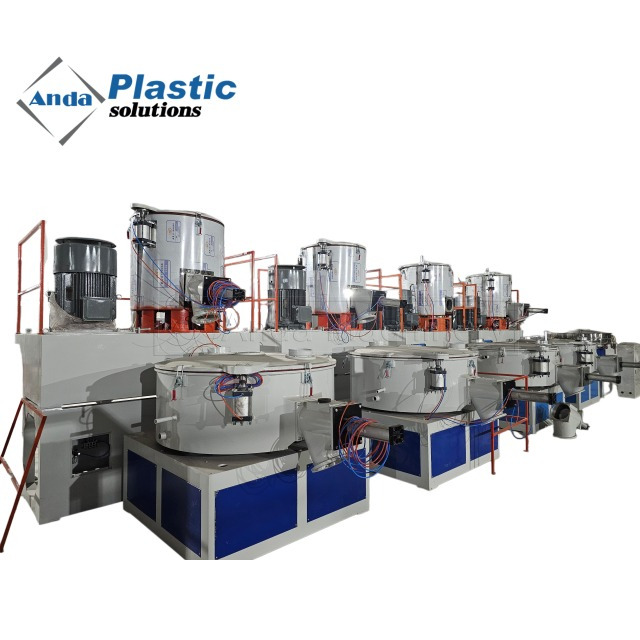
The SRL-Z 500/1000 High-Low Speed Plastic Mixer Unit for PVC Powder combines a high-speed hot mixer with a low-speed cooling mixer.
The listed configuration includes:
Parameter | Specification |
|---|---|
Model | SRL-Z 500/1000 |
Hot Mixer Capacity | 500 L |
Cold Mixer Capacity | 1000 L |
Main Application | PVC resin, plastic powders, fillers, and additives |
Process Function | Hot mixing followed by cooling |
Applicable Production | PVC pipe, profile, sheet, and board manufacturing |
Actual batch weight and production output depend on formulation bulk density, operating conditions, and the equipment's approved working capacity.
A suitable hot and cold mixing system should support:
Controlled ingredient mixing
Stable material temperature monitoring
Effective cooling
Consistent material transfer
Reliable operation across repeated batches
For projects requiring additional feeding or dosing equipment, the complete material preparation workflow should be evaluated together.
When discussing PVC mixing equipment with ANDA Machinery, provide the following details:
PVC product type: pipe, profile, sheet, wall panel, or other application
Rigid or flexible PVC formulation
Main raw materials and filler content
Required batch weight or hourly material consumption
Existing mixing equipment
Target extrusion line capacity
Current mixing or cooling problems
Available factory utilities and installation space
This information helps determine an appropriate equipment configuration and production arrangement.
PVC dry blend may form lumps because of insufficient cooling, excessive thermal exposure, moisture, incorrect liquid additive feeding, or material buildup inside the mixer.
If lumps develop only during storage, investigate storage conditions and condensation as well as the mixing process.
Poor flowability may result from moisture, agglomeration, unsuitable additive distribution, particle characteristics, or inadequate cooling.
Hopper geometry and feeder configuration can also affect powder discharge.
Bulk density can change because of raw material variation, incorrect ingredient dosing, different mixing conditions, or inconsistent measurement methods.
Compare samples using the same test procedure before adjusting equipment settings.
Yellowing may be associated with excessive thermal exposure, stabilizer imbalance, contamination, or changes in raw materials.
If the powder appears normal but the extruded product turns yellow, investigate downstream processing conditions.
Improve additive distribution by verifying ingredient dosing, using the correct addition sequence, maintaining suitable mixer loading, and checking mixing blade condition.
The appropriate procedure depends on the formulation and additive supplier's recommendations.
Hot mixing combines formulation ingredients under controlled mechanical agitation and temperature increase.
Cold mixing removes excess heat and prepares the dry blend for subsequent handling, storage, or extrusion feeding.
Yes. Moisture can contribute to gas formation and defects during extrusion.
However, bubbles may also result from other volatile materials, trapped air, or extrusion processing conditions.
Start with the raw material lot, formulation weights, ingredient addition sequence, hot mixing temperature, cooling conditions, and mixer cleanliness.
Compare these values with records from a stable production batch.
Inspection frequency depends on operating hours, formulation abrasiveness, equipment design, and manufacturer recommendations.
Changes in mixing time, vibration, or material distribution may indicate that an additional inspection is needed.
No. A high-speed mixer is one part of the material preparation process.
Consistent dry blend quality also depends on raw material condition, dosing accuracy, cooling, storage, conveying, and downstream processing.
PVC dry blend mixing problems often appear as powder lumps, poor flowability, bulk density variation, discoloration, uneven additive dispersion, moisture-related defects, or inconsistent batch quality.
The most effective troubleshooting approach is to identify the symptom, verify the material condition, review the formulation and process records, and then inspect the relevant mixing or cooling equipment.
Consistent dosing, controlled hot mixing, effective cooling, and regular equipment maintenance help manufacturers improve the repeatability of PVC dry blend preparation.
For PVC pipe, profile, sheet, and wall panel production, a properly configured hot and cold mixing system can support stable raw material preparation before extrusion.
Need a Reliable PVC Hot and Cold Mixing Solution?
ANDA Machinery provides PVC mixing equipment for industrial powder preparation and extrusion production applications.
Contact ANDA Machinery with your formulation, required capacity, and current mixing challenges to discuss a suitable PVC mixing system.


