 English English

Views: 0 Author: Site Editor Publish Time: 2026-10-28 Origin: Site


The growing demand for high-quality recycled polymer powders in compounding, rotomolding, and masterbatch production has exposed a critical processing flaw: treating all polyolefins as identical materials during size reduction. Attempting to mill Polyethylene (PE) and Polypropylene (PP) with the same aggressive parameters leads to thermal degradation, poor powder flowability (jagged morphology), rapid machine wear, and severe throughput bottlenecks due to screen blinding. Achieving optimal particle size distribution (PSD) and bulk density requires aligning the pulverizing technology with the specific thermal and mechanical properties of the polymer, as well as its initial form factor (rigid regrind vs. film flakes). This guide breaks down the material differences, grinding challenges, and technical criteria for evaluating and configuring a PE PP Plastic Pulverizer for maximum yield and powder quality.
Establishing the baseline physical properties of the input material determines the necessary mechanical force, thermal thresholds, and feeding mechanisms for successful pulverization. Plant operators often make the mistake of loading mixed polyolefins into a mill without adjusting the gap or cooling parameters. This guarantees poor powder quality and frequent machine jams. You must evaluate the melt flow index (MFI), structural density, and material elasticity before starting the milling process. High-MFI materials melt faster under friction. Low-density materials require specialized force-feeding. Mapping these properties directly dictates how you configure the equipment.
Polyethylene variants, specifically LDPE, HDPE, and LLDPE, exhibit high ductility. They stretch and deform rather than shatter under blunt impact. These materials also possess low melting points, typically ranging between 115°C and 135°C. This creates a high risk of smearing and agglomeration inside the milling chamber. You require a distinct shearing and cutting action to process PE effectively. Clean particle separation demands sharp cutting geometries on the grinding disks. If the teeth lack sharpness, the PE simply stretches, absorbs kinetic energy, and heats up rapidly. This leads to a melt-fusing event, where the plastic coats the internal housing and locks the rotor.
Polypropylene features a higher melting point (around 160°C), greater structural density, and increased rigidity compared to PE. It behaves differently under high-speed impact. PP exhibits a balance of brittleness and elasticity, making it highly suitable for circular economy manufacturing. It shatters more predictably when struck by a high-speed rotor. However, you must differentiate between the natural hardness of pure PP and the extreme abrasiveness of filled PP. Pure PP processes easily with standard steel tooling. Filled PP compounds, containing glass fiber, calcium carbonate, or talc, act like sandpaper inside the milling chamber. This extreme abrasiveness directly impacts tooling wear, requiring specialized metallurgy to prevent rapid blade degradation.
The physical state of the pre-processed material alters bulk density drastically and dictates the required infeed technology. Dense rigid packaging regrind flows predictably through standard gravity chutes. The weight of the material pulls it down into the cutting chamber at a steady rate. Lightweight film flakes behave entirely differently. They bridge, tangle, and surge inside the feed hopper. You cannot feed film flakes using gravity alone. Proper dosing requires mechanical intervention to ensure the pulverizer maintains a steady amp load. Inconsistent feeding causes power spikes, uneven particle size distribution, and sudden drops in throughput.
| Material Property | Polyethylene (PE) | Polypropylene (PP) | Milling Implication |
|---|---|---|---|
| Melting Point | 115°C - 135°C | 160°C - 165°C | PE requires aggressive water cooling to prevent smearing. |
| Ductility | High (Stretches) | Moderate (Shatters under impact) | PE needs sharp shear cutting; PP responds well to blunt impact. |
| Abrasiveness (Unfilled) | Low | Low to Moderate | Standard hardened steel tooling is sufficient for unfilled grades. |
| Abrasiveness (Filled) | N/A (Rarely filled heavily) | Extremely High (Glass/Talc) | Filled PP requires tungsten carbide coated blades and liners. |
Mapping common processing failures to specific mechanical deficiencies helps you select better equipment. Standard milling equipment often fails when processing polyolefins because it lacks the necessary thermal controls or specialized feeding mechanisms. You must evaluate how specific machine features directly influence production outcomes. A lack of cooling surface area leads to melted plastic. Poor rotor design leads to jagged particles. Understanding these dimensions prevents procurement mistakes and operational downtime.
Frictional heat generated during downsizing directly alters the Melt Flow Index (MFI) of the polymer. Excessive heat degrades the plastic, changing its molecular weight and making it useless for strict downstream applications. Material smearing occurs when the polymer reaches its softening point inside the chamber. The plastic coats the grinding disks and stator walls. This sticky layer rapidly accumulates more incoming material. Within minutes, this leads to machine jams. Clearing a melt-fused pulverizer requires hours of manual labor.
Operators must follow strict procedures to recover from a melt-fusing event:
Achieving a tight micron range is a strict requirement for specific applications. Rotomolding requires a precise 300-500 micron range. A wide, unusable distribution containing excessive fines or oversized particles causes surface defects, pinholes, and weak structural points in molded parts. Milling action directly dictates particle shape and powder morphology. Spherical particles offer high dry flowability. This allows the powder to flow like water, which is essential for rotomolding and efficient compounding. Jagged particle shapes interlock and resist flow. This causes bridging in downstream masterbatch hoppers and poor mixing in extruders.
Vibrating screen blockages severely cripple production rates. Static electricity generated during the fracturing of polymer chains causes fine powder to cling to the screen mesh. Irregular, jagged particle shapes wedge themselves into the screen openings. High ambient moisture content exacerbates these blockages by causing the dust to clump. This creates a compounding negative effect. Oversized particles cannot pass through the blinded screen. They recirculate continuously back into the milling chamber via the pneumatic conveying system. This overloads the motor, generates excessive frictional heat, and destroys throughput efficiency.
Lightweight film flakes lack the mass to feed consistently via gravity. They cause severe bridging and surging issues in the hopper. The pulverizer starves for material one moment and chokes the next. Rigid plastic granules provide a predictable, steady flow. You must adapt your feeding strategy based on the input material. Failure to manage material infeed results in wildly fluctuating motor loads. When the motor amps spike, the internal temperature spikes with it, increasing the risk of thermal degradation.
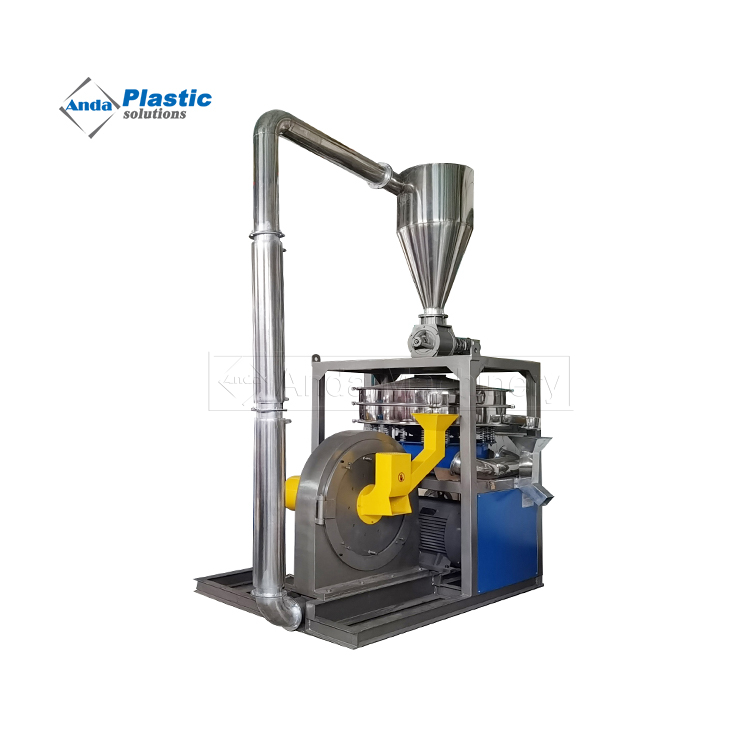
Comparing the primary machine architectures available for polyolefin size reduction is a mandatory step in plant design. No single machine handles every polymer perfectly. You must match the machine architecture to your specific material properties and production goals. The two dominant technologies in the recycling sector are grinding disk pulverizers and turbo mill pulverizers. Each offers distinct mechanical advantages and specific operational limitations.
This mechanism relies on serrated stationary and rotating disks. The material passes through a precise, adjustable gap between these disks. It undergoes intense friction and shear forces as the teeth cut the polymer. These machines are ideal for ambient grinding of PE. They excel in producing highly spherical powder for rotomolding, masterbatch, and flexible applications. However, they have limitations regarding heat. Disk pulverizers generate higher internal temperatures due to the intense friction. They require precise water-cooling jackets integrated into both the stationary door and the bearing housing, along with strict temperature monitoring.
Turbo mills utilize high-speed turbine rotors equipped with impact plates. These rotors spin at high RPMs, creating intense air vortices and high-impact forces. The material shatters upon impact with the rotor and the corrugated stator walls. They are highly effective for rigid PP and dense structural plastics. Materials requiring high-volume airflow cooling benefit greatly from this design. The massive airflow generated by the turbine naturally cools the grinding chamber and conveys the material simultaneously. The main limitation is fines generation. Turbo mills can produce excessive dust if the internal classification and draft fan speeds are not optimized.
| Technical Specification | Grinding Disk Pulverizer | Turbo Mill Pulverizer |
|---|---|---|
| Primary Reduction Mechanism | Friction and Shear Cutting | High-Speed Impact and Air Vortex |
| Optimal Material Match | Polyethylene (LDPE, HDPE, LLDPE) | Polypropylene (Rigid PP, Filled PP) |
| Resulting Particle Morphology | Highly Spherical (Excellent Flow) | Slightly Jagged to Spherical |
| Primary Cooling Method | Chilled Water-Jacketed Chambers | High-Volume Induced Airflow |
| Maintenance Focus | Disk Sharpening and Gap Calibration | Impact Plate Replacement and Balancing |
Ambient grinding occurs at room temperature using standard water and air cooling methods. Cryogenic grinding utilizes liquid nitrogen to embrittle the polymer before it enters the milling chamber. You must conduct a strict operational analysis before choosing cryogenics. Cryogenic systems are highly effective for high-MFI or highly elastic polymers that melt instantly under ambient friction. The extreme cold shatters the plastic easily, preventing any thermal degradation and doubling throughput. However, liquid nitrogen consumption is expensive. The operational cost of cryogenic milling is only justified by extreme powder quality requirements, medical-grade applications, or massive throughput gains that offset the gas costs.
You must identify the non-negotiable technical specifications required for continuous operation. Industrial-scale production demands robust engineering. Weak components will fail under the stress of 24/7 polyolefin milling. Evaluate scalability, wear resistance, and safety compliance. These dimensions separate entry-level machines from true industrial workhorses capable of processing thousands of pounds per hour.
Evaluate vibratory feeders and gravity chutes for processing rigid regrind. These systems work well for dense materials, providing a steady flow based on vibration frequency. However, you must demand force-feeding augers, known as crammers, for lightweight film flakes. A crammer physically pushes the fluffy material down into the grinding chamber using a motorized screw. This maintains consistent throughput and prevents hopper bridging. The crammer motor must be linked to the main drive motor via a PLC. If the main motor amps rise, the crammer automatically slows down to prevent choking.
The importance of wear-resistant alloys dictates your maintenance schedule. Processing abrasive, filled PP compounds destroys standard steel blades rapidly. Look for tungsten carbide coatings, specialized hardened alloys, or replaceable wear liners. These materials extend blade life significantly and maintain a sharp cutting edge longer. Additionally, demand micro-metric gap adjustment mechanisms. This allows precise control over particle size. The best systems allow operators to adjust the grinding gap externally using a calibrated dial without requiring a machine shutdown or opening the housing.
Evaluate machines offering dual-cooling systems. The best setups combine water-jacketed grinding chambers with induced draft air cooling. This removes heat from the metal components and the material simultaneously. Automated temperature monitoring is a strict requirement. Thermocouples must link directly to the feed rate controls. If the chamber temperature spikes near the polymer's softening point, the system automatically throttles the infeed. This auto-throttling prevents melt-fusing events entirely, protecting the equipment from operator error.
Integrated rotary or vibratory sifters determine your final powder quality. The screen separates the acceptable powder from the oversized particles. Pneumatic conveying systems are essential for material transport. They pull the milled material from the chamber, cool it during transit, and deliver it to the sifter. They also automatically return oversized particles to the grinding chamber. This closed-loop system operates without manual intervention. It ensures 100% of your output meets the exact micron specification required by your customers.
Understanding the hidden costs of operating a pulverizing line ensures long-term profitability. The initial purchase price is only a fraction of the total investment. You must account for energy consumption, maintenance downtime, and tooling replacements. Implementing strict risk mitigation strategies protects your margins. Proper facility planning ensures the equipment delivers consistent value rather than constant operational headaches.
Proper upstream granulation is a strict prerequisite for efficient milling. You must achieve a uniform 8-10mm regrind before the material enters the pulverizer. Feeding oversized or irregular chunks destroys pulverizer blades, causes severe power spikes, and damages the rotor bearings. The pulverizer is designed for fine size reduction, not primary crushing. Investing in a high-quality granulator upstream protects your pulverizing investment and ensures steady, predictable throughput.
The relationship between target micron size and energy draw is non-linear. Finer powder requires exponentially more power to produce. Pushing a machine to produce 200-micron powder will slash your throughput by more than half compared to producing 500-micron powder. You must optimize motor efficiency to control utility costs. Implement Variable Frequency Drives (VFDs) on the main motors and draft fans. VFDs adjust power consumption based on actual load, saving significant energy costs over time and reducing mechanical stress during startup.
Predict the lifecycle of grinding disks and turbo blades accurately based on your material stream. Base your predictions on material hardness and abrasiveness. Processing glass-filled PP will require blade replacements ten times faster than pure PE. Evaluate the machine design for accessibility. Look for quick-opening split housings and swing-away doors. These designs allow rapid cleaning, fast color changes, and quick blade swaps. Difficult-to-access chambers result in unacceptable maintenance downtime and increased labor costs.
Mitigating combustible dust hazards is an absolute necessity in powder production. Fine plastic powder suspended in air creates highly explosive environments. Standard dust collectors are insufficient and dangerous. You must implement ATEX-compliant explosion venting on all filtration units and silos. Install rotary valves to isolate explosion zones and prevent flame propagation. Utilize high-efficiency cyclone filtration systems to capture volatile fines safely before they reach the baghouse. Ignoring dust safety compliance puts your facility and personnel at extreme risk of catastrophic deflagration.
To ensure successful implementation and maximize the operational lifespan of your size reduction equipment, execute the following steps:
A: Yes, but it requires significant operational adjustments. You must change the grinding gap, adjust the rotor speed, and modify the cooling parameters. Processing PE requires strict temperature control to prevent melting, while PP requires managing impact forces. Using identical settings for both materials will result in poor powder quality or machine jams.
A: The ideal particle size distribution for rotomolding typically ranges between 300 and 500 microns. The powder must also possess a highly spherical morphology. This ensures excellent dry flowability, allowing the plastic to coat the inside of the mold evenly without leaving pinholes or surface defects.
A: Preventing melt-fusing requires integrated thermal management. You must utilize water-jacketed grinding chambers and high-volume induced draft air cooling. Furthermore, install automated temperature sensors linked to the material infeed. If the internal temperature approaches the polymer's softening point, the system must automatically reduce the feed rate.
A: A plastic granulator performs primary size reduction, chopping large plastic parts into 8-10mm rigid flakes. A plastic pulverizer performs secondary size reduction, grinding those 8-10mm flakes into a fine powder under 1000 microns. Granulators use blunt cutting knives, while pulverizers use high-speed friction disks or turbo rotors.
A: Yes, the input form drastically affects the process. Rigid regrind flows easily through gravity chutes and maintains a steady motor load. Lightweight film flakes bridge in standard hoppers and cause surging. Processing film flakes requires specialized force-feeding augers to maintain consistent throughput.
A: Natural polymer hardness causes standard wear, but abrasive fillers destroy blades rapidly. Processing pure PE or PP allows for long tooling lifecycles. However, processing PP filled with glass fibers or talc acts like sandpaper inside the chamber. You must use tungsten carbide-coated blades to withstand abrasive compounds.
A: Cryogenic pulverizing is necessary when processing polymers with extremely high melt flow indices or high elasticity that cannot be milled at ambient temperatures. Liquid nitrogen embrittles the plastic, preventing thermal degradation. It is only used when the high operational costs are justified by strict quality requirements.


