 English English
 |


| Quantity: | |
|---|---|
China
JINSE
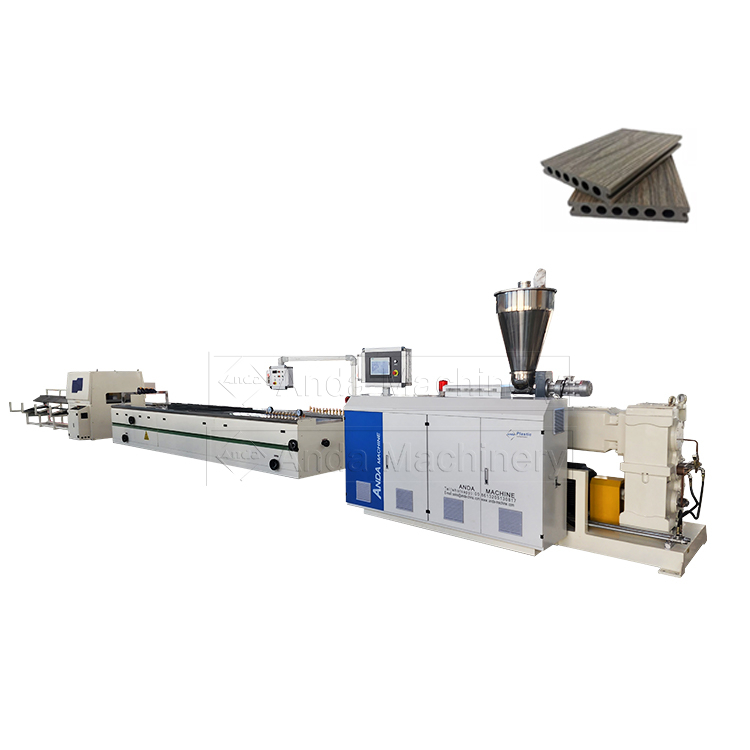
WPC Decking Machine mainly composed by conical Twin Screw Extruder, Cooling Table, Hauling Machine, Cutting Machine, Stacker.
WPC Profile is a new type environment protection material made by PE, PP or PVC with plant fiber through mixing and extrusion. Comparing with convebtional material, it has the features of water proof, damp proof, insect prevention, environmental protection, etc.
WPC Decking Machine is based on many years practical experience with matured technique and reliable performance. Based on different plastics, it has two step or one step production method to produce WPC products for different application.
Main Features of Wood Plastic Composite Wpc Flooring Decking Fencing Profile Making Machine Line:
1. Extruder speed and haul off speed controlled by ABB frequency converter, saving power and easy to adjust speed.
2. Extruder temperature adopt PID control, temperature fluctuation self adjusting, it realizes the high automatic level.
3. Lower power consumption, it can save 25-30% electrical power consumption comparing with most kind PVC production line.
4. Easy and convenient for operation and maintain, with economical price, suitable for large scale investment.
5. High output and efficiency, fast to recover the investment cost.
Technical parameter:
Model | 65 | 80 |
Screw Diameter | 55/110 | 65/132 |
Main Motor Power | 37 | 55 |
Output (kg/hour) | 50-150 | 150-200 |
1.WPC Decking Machine-Extruder
2.WPC Decking Machine-Cooling Machine
3.WPC Decking Machine-Cutting Machine
Raw Material Preparation: Mix plastic particles (PE/PP/PVC), wood fiber, coupling agent, anti-aging agent, and other additives in a certain proportion, and put them into the raw material mixer for uniform mixing.
Extrusion: The mixed raw materials are fed into the conical twin-screw extruder through the feeding hopper. Under the action of high temperature (160-200℃) and high pressure, the raw materials are melted and plasticized, and then extruded into the decking mold through the extruder head to form the initial shape of the WPC decking board.
Cooling & Shaping: The extruded decking board is conveyed to the cooling table, and cooled by water and air to room temperature, so that it is fully shaped and its dimensional stability is ensured.
Traction: The cooled decking board is pulled by the traction machine at a constant speed, ensuring that the board has a uniform cross-section and length.
Cutting: The continuous decking board is cut into fixed-length products by the cutting machine according to the set length.
Stacking: The cut decking boards are automatically stacked by the stacking machine, and then packaged and stored after inspection.
The control panel is simple and intuitive, with clear operation prompts, and operators can master the operation skills after simple training. All components are designed with easy maintenance, and the wearing parts (screw, barrel, saw blade) can be easily replaced, reducing maintenance costs and downtime.
Outdoor landscapes: parks, scenic spots, pedestrian streets, and garden corridors.
Residential areas: balconies, terraces, courtyards, and community trails.
Commercial places: shopping malls, hotels, restaurants, and commercial plazas.
Industrial areas: factory workshops, warehouses, and logistics yards.
Public facilities: bridges, docks, and coastal areas (with strong corrosion resistance).


